Display exploring the life and work of poet Joan Brossa opens in Exeter
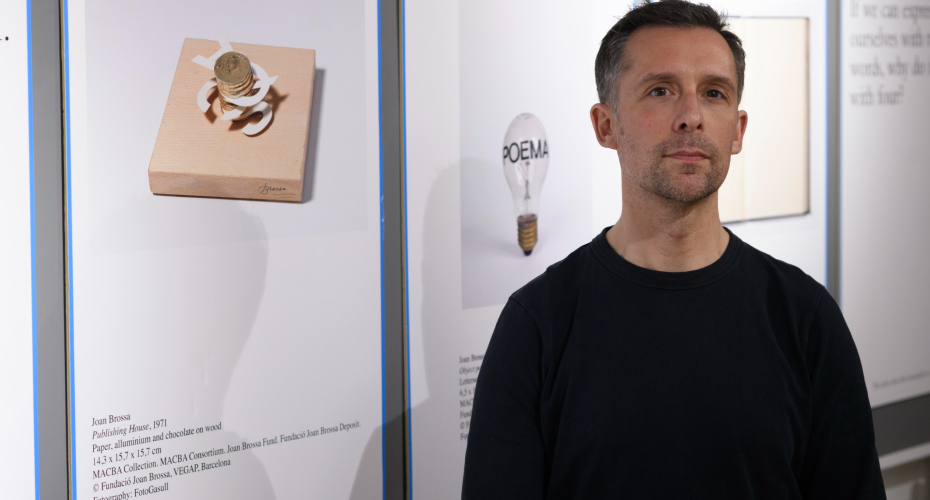
Dr Richard Mansell. Photos by Steve Haywood
A display exploring the life and work of Catalan poet, artist and writer Joan Brossa is now on show at the University of Exeter, following similar presentations in Barcelona and Manchester.
Born in Barcelona in 1919, Brossa described himself above all as “always a poet”. Working across literary, visual, scenic and object-based forms, his work consistently pushed at the limits of language and communication. Created under the oppressive conditions of the dictator General Franco’s regime, Brossa’s poetry sought freedom through experimentation, irony and the absurd, inviting audiences to question meaning, reality and interpretation.
Positioning himself as a bridge between avant-garde movements, Brossa forged close artistic relationships with key figures of the Catalan avant-garde, including Joan Miró, and later became an important point of reference for younger postmodern artists. His work explored the power of words to name and potentially transform reality, while maintaining a sharp sense of rebellion and provocation.
A version of this display was first held at the Centre de les Arts Lliures in Barcelona between November 2023 and June 2025. To mark Manchester’s role as guest city at Barcelona’s La Mercè festival in September 2025, the display was then presented at the University of Manchester. Its arrival in Exeter recognises and celebrates the collaboration between Manchester, Barcelona and Exeter as UNESCO Cities of Literature.
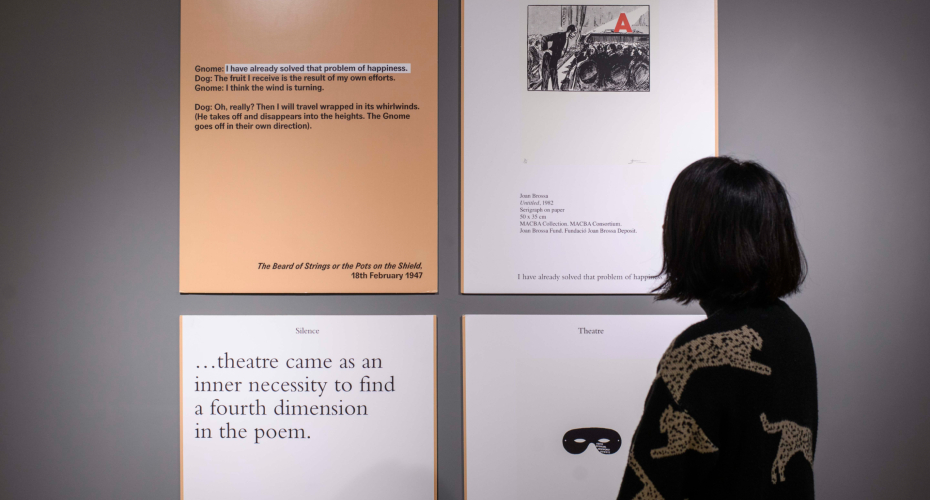
The Exeter display includes a series of boards exploring different aspects of Brossa’s life and work, alongside a short film played on a loop, featuring home videos of Brossa and his friends lampooning theatre, performances, bombastic cultural critics and the self-righteous spokespeople of Franco. The display also features additional contextual material curated by Dr Richard Mansell, Senior Lecturer in Translation in the University of Exeter’s Department of Languages, Cultures and Visual Studies, and Corresponding Member of the Institut d’Estudis Catalans, who has curated the Exeter version of the exhibition.
Dr Mansell said: “I hope that audiences take away a sense of the complexity and conflict behind Brossa’s work, where he was driven to search for and reveal poetry in everyday items and acts, where there was no border between visual and verbal poetry, and where dedication to Catalan as a language of expression was a political act in itself.”
Naome Glanville, Arts and Culture Co-ordinator added: “We’re delighted to have the opportunity to show this exhibition, which sheds a light on the work of such an influential poet and artist. Both his words and visual art invite us to think about how a creative person can make a difference in difficult circumstances.”
The display can be viewed in the University’s Arts and Culture display space in the west wing foyer of the Queen’s Building on the University of Exeter’s Streatham Campus (next to Queen’s café) until Friday 27th March 2026.