University welcomes Dubai documentary crew for new programme on its archival collections of the Arab world
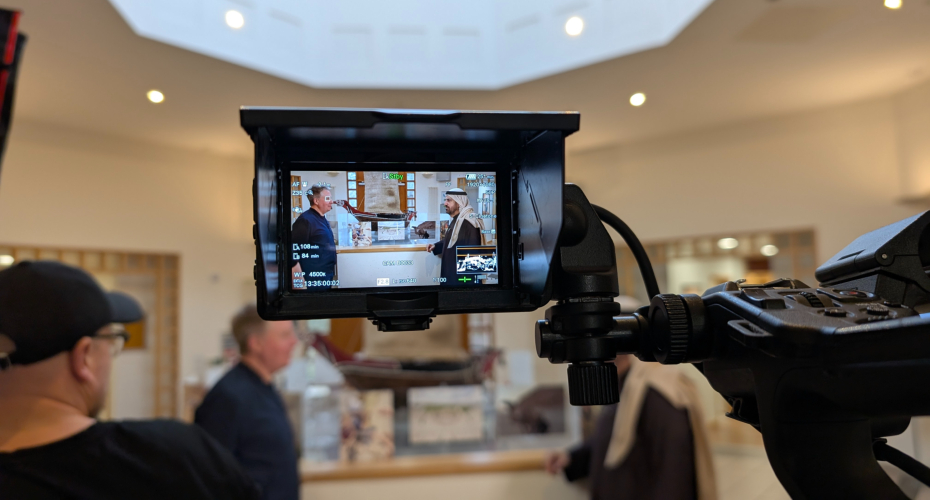
The University of Exeter and its collection of cultural artefacts relating to the Emirates are to be showcased to millions of television viewers across the Gulf region.
Producers of the Al Rawi programme – a popular history and culture documentary in Dubai – visited the Streatham campus and recorded extensive interviews with academics and archivists at the University.
They also captured footage of some of the photos, pictures and documents held in both the Special Collections and the Institute of Arab and Islamic Studies (IAIS).
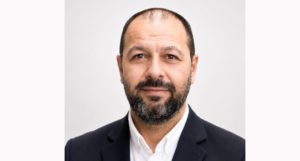
The visit was led by His Excellency Jamal Bin Huwaireb, CEO of the Mohammed Bin Rashid Al Maktoum Knowledge Foundation, and cultural advisor to the Dubai government.
An Emirati historian and writer of Nabataean poetry, His Excellency Bin Huwaireb has presented more than 450 episodes of Al Rawi since 2009, documenting Arab and Islamic heritage around the world.
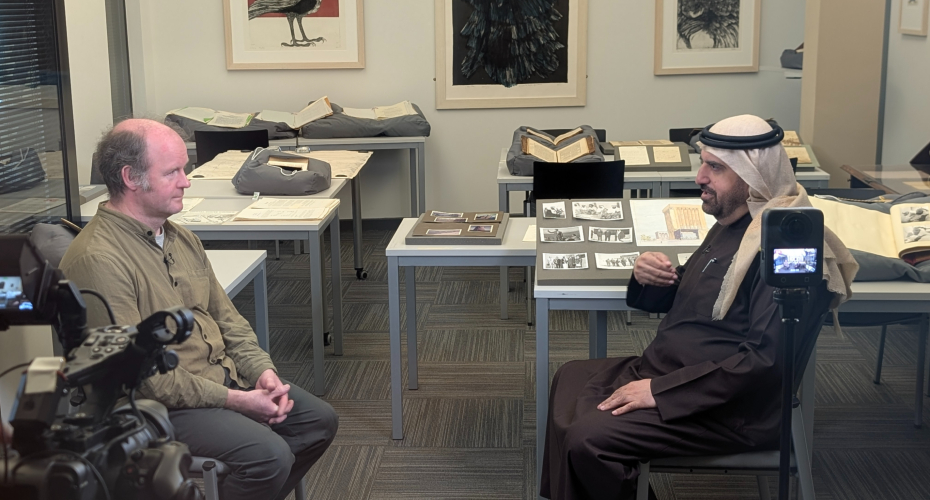
“The name of the show means The Narrator, and we are narrating the history of the Gulf from 1900 to today,” he said. “We have filmed in libraries, universities, galleries and cities around the world, focusing on topics as varied as horses, cars, and people – many of whom travelled from the UK to make their mark in the Emirates, including Wilfred Thesiger, Jack Briggs and Ronald Codrai.
“The archives here in the University of Exeter are very important, and I want people to understand this. I had no idea quite how big they were until I came, and I think many viewers will be interested in the story we will tell.”
The University has more than 500 separate archives within Special Collections, 60 of which relate to the Middle East. These are curated by Dr James Downs, Archivist of the Middle East Collections, Project Manager for the Digital Archive of the Middle East, and Librarian for the Arab World Documentation Unit (AWDU) within IAIS.
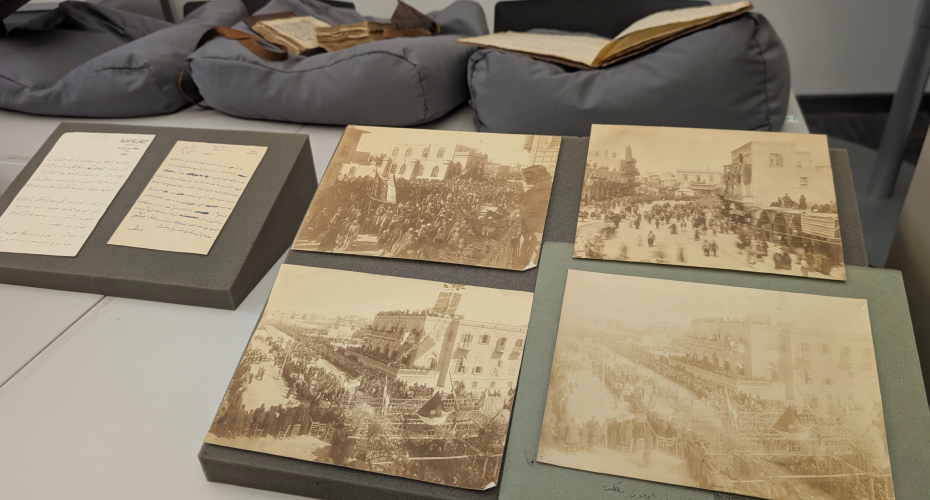
Dr Downs prepared a small selection of archive material with a particular focus on Dubai and the wider Gulf, as well as some older Arabic manuscripts, including a 19th-century Qur’an.
He said: “Much of this material relates to the careers and activities of British diplomats, journalists, campaigners, and travellers who lived and worked in the region during the 20thcentury. Several of the photos and papers are from the archives of Sir William Luce (EUL MS 146 and MS 474) and Glen Balfour Paul (EUL MS 370), who both had diplomatic posts in the Gulf. Of particular interest are Luce’s papers recording his conversations with Gulf rulers (including Sheikh Rashid of Dubai) in 1970-1 as part of his ‘shuttle diplomacy’ in negotiating the formation of the UAE.”
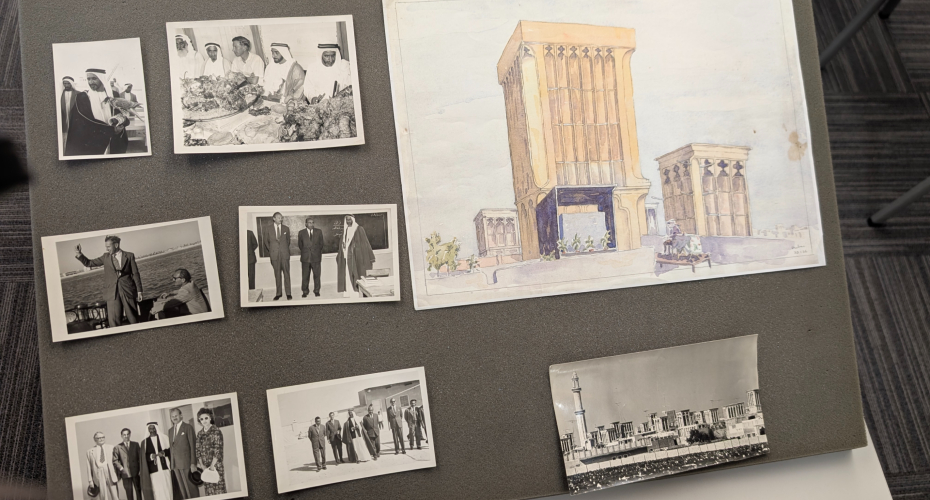
In the afternoon, the team moved to IAIS, where they filmed some of the collections in the AWDU, and interviewed Professor William Gallois, the Institute’s Director, and Professor Helen Berry, Deputy Pro Vice-Chancellor in the Faculty of Humanities, Arts and Social Sciences.
Professor Gallois was filmed in front of a model of a pearl fishing dhow, believed to have been made in Bahrain in the 1950s or 60s, and donated to the University in memory of Peter Keegan, the late Chairman of publisher Kegan Paul.
“One of the reasons why IAIS is so special is because it is home to a vibrant community of scholars who are connected to the Islamic world in a multitude of ways,” said Professor Gallois. “And we are a significant ‘exporter’ of maritime archaeological expertise, which makes this model dhow such a fitting backdrop, one that is emblematic of the pearling economy that was prevalent before the development of the oil industry.
“Thanks to the Al Rawi programme, we will be sharing such artefacts with new audiences across the Arab world. Our hope is that this will lead to academic opportunities with universities in the region, and the creation of new links with local cultural bodies.”
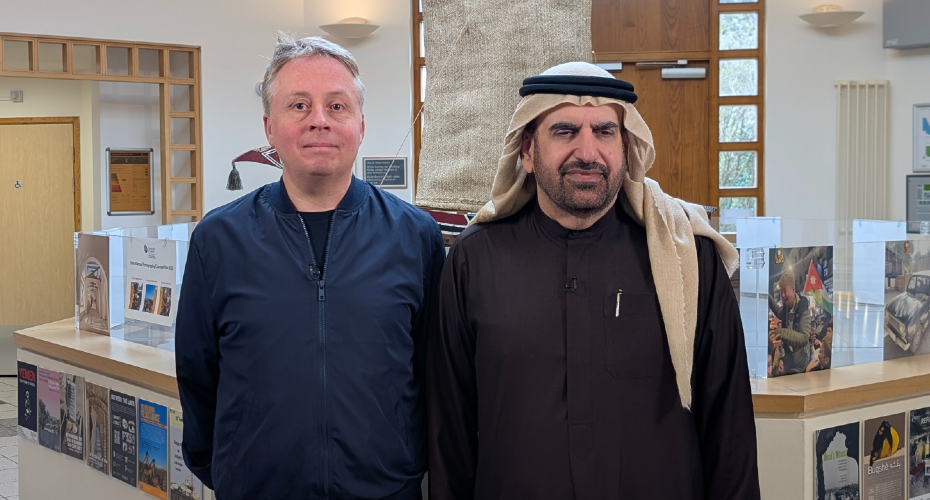
Launched in 2007, the Mohammed bin Rashid Al Maktoum Knowledge Foundation has led and implemented pioneering programmes aimed at establishing Dubai and the UAE as a global centre for knowledge and research. The foundation has worked with several UK universities to fund scholarships for Arab undergraduate and postgraduate students, including the University of Oxford.
His Excellency Bin Huwaireb said the filming will enable his team to create two documentaries on the University, which will be broadcast on Emirati television.
The visit was supported by the University’s Global Advancement team.