South West teenagers learn about horrors of antisemitism at major regional Holocaust Memorial Day conference
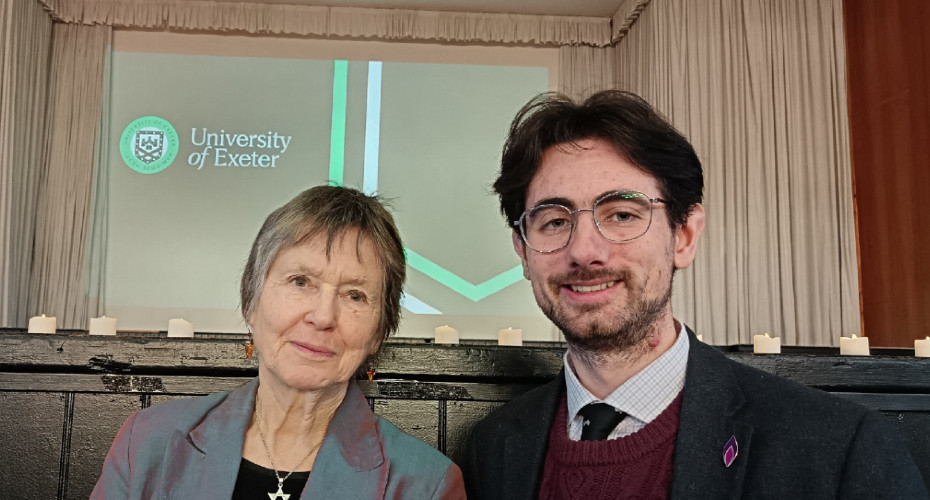
Dr Barnabas Balint with Rosemary Schonfeld
Teenagers from across the South West learned about the horrors and impact of antisemitism from personal histories and academic experts at the region’s flagship Holocaust Memorial Day education event.
The University of Exeter conference was founded by Dr Barnabas Balint while an Exeter undergraduate history student in 2017 to bring teenagers together to learn about the past and the lessons they can take to create a brighter future.
More than 1,400 young people from the South West have now attended the HMD conference.
A member of the ‘second generation’, Rosemary Schonfeld, from Devon, whose uncles and grandparents were murdered in Auschwitz, told pupils her family’s story.
Dr Balint and University of Exeter academics who conduct research into the Holocaust – Professor David Tollerton and PhD candidate Leah Lawford – ran workshops for students on topics including the lives of Holocaust victims, the artwork of Holocaust survivor Samuel Bak, and the legacy of the genocide in Rwanda.
This year a total of 180 pupils in years 10, 12 and 13 from six schools in Devon and Cornwall – Stoke Damerel Community College; St James School; Magna Academy; Callywith College, Falmouth School and Teignmouth Community School – attended the event.
Dr Balint, who now researches the history and legacy of the Holocaust, said: “This event feels even more poignant because of the rise in antisemitism in the UK. Holocaust Memorial Day is a reminder that the responsibility of remembrance doesn’t end with the survivors – it lives on through their children, their grandchildren and through all of us.”
Rosemary’s presentation showed how quickly antisemitism spread following the Nazi invasion of the then Sudentenland, now the Czech Republic, which had a huge impact on Jewish people, destroying their daily life and removing their civil rights.
Rosemary is the daughter of a Czech refugee who came to England after the Holocaust. She grew up unaware her father was Jewish. As an adult she started tracing the story of her relatives and learned more about the deaths of her uncles and grandparents, as well as their role in the Czech resistance. She tracked down Relly, who had been married to her father’s brother and survived Auschwitz.
After surviving the Holocaust, Relly married and raised her family in Israel and Australia. Rosemary visited her on many occasions after the pair, when she was welcomed as a long-lost niece. Their reunion had a significant impact on her life and their conversations helped Rosemary understand what happened to her family.
As well as sharing her story, Rosemary helped pupils understand the changing geography of Europe after the First World War and the part that played in Jewish migration across the continent, as well as Hitler’s invasion of Czechoslovakia.
Rosemary also spoke to pupils about the parallels they could take from the explosion of fake news online today, and some coverage in the media about migration, and the false information circulated about Jewish communities in the 1930s and 1940s.
Reflecting on the event, one student said: “I think that young people have a big responsibility in preserving the memory of the Holocaust. Young people need to learn about it and spread awareness so that everyone knows what happened and can prevent it from happening again.”