Exeter mathematician recognised by the Royal Astronomical Society
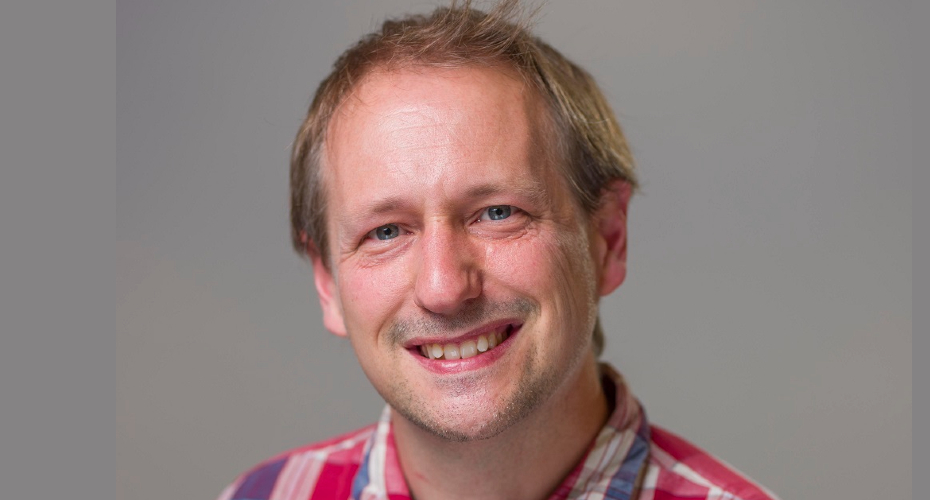
A mathematician who specialises in studying the dynamics at play in the solar atmosphere has been recognised by the Royal Astronomical Society.
Professor Andrew Hillier has been awarded the James Dungey Lectureship in honour of his “exceptional ability to explain complex plasma processes in the solar atmosphere in an engaging manner”.
Professor Hillier, Co-Director of the Exeter Centre for Mathematical Sciences, will now deliver a keynote lecture at one of the society’s Ordinary meetings this year.
The announcement came as the RAS revealed its awards, medals and prizes for 2026, in recognition of significant achievements in the fields of astronomy and geophysics. In awarding Professor Hillier the James Dungey Lectureship, they referenced his significant research breakthroughs in the field of plasma physics applied to the Sun’s atmosphere.
“From a firm mathematical footing, he has worked on the Kelvin-Helmholtz instability and two-fluid models in partially ionised plasmas,” said the judges. “In particular, he has examined the instability of shear flows in magnetised partially ionised plasmas – a problem of wide interest, as its understanding is crucial for our modelling of the heating and cooling of the solar atmosphere.”
They added that Professor Hillier “possesses the uncommon ability to capture the fundamental physics at play in complex problems and convey them with outstanding communication skills, enthusiasm, and a clear and direct language. This, combined with his exceptional science insights, enables his audience to grasp the results in an engaged and straightforward manner.”
Professor Hillier, of the Department of Mathematics and Statistics, specialises in what is known as Magnetohydrodynamics, both in a fundamental sense and in the context of the solar atmosphere.
His work combines analytic results with simulations and analysis to offer a balanced understanding of the dynamics we can observe in the solar atmosphere. A key part of his research is co-leading the Solar Atmospheric Modelling Suite project, with researchers at Cambridge, Sheffield and Warwick, which is developing the next generation of modelling tool for the solar atmosphere.
Professor Hillier says his lecture will focus on how we can use mathematical modelling of turbulence to understand how the solar atmosphere is both heated and cooled, which is one of the most fundamental questions in solar physics.
“The list of previous winners contains so many scientists I really look up to, so I am very honoured to be selected to give this prize lecture,” he added.
For more than 200 years, the RAS has recognised researchers, educators and those committed to outreach, beginning with English mathematician Charles Babbage and German astronomer Johann Franz Encke, who were jointly handed the first RAS Gold Medal in 1824.
In Professor Hillier’s case, the lectureship he receives is named after James Wynne Dungey (1923–2015), a British space scientist who was pivotal in establishing the field of space weather and who made significant contributions to the fundamental understanding of plasma physics.
For more details, visit the RAS website.