Study confirms Arctic peatlands are expanding
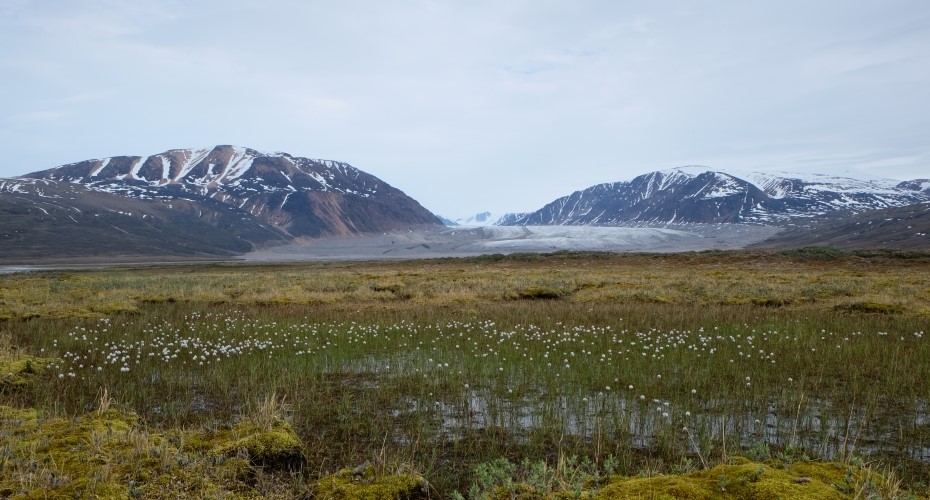
Peatlands on Bylot Island, Canada. Credit Angela Gallego-Sala
New research confirms Arctic peatlands are expanding as temperatures continue to rise.
The Arctic is warming faster than the rest of the planet, with average temperatures increasing by about 4°C in the last four decades.
The new study, led by the University of Exeter, shows peatlands have expanded since 1950, with some peatland edges moving by more than a metre a year.
Given that the study covered a broad range of Arctic conditions – with 91 samples from 12 sites in the European and Canadian Arctic – the researchers say peatland expansion is likely to be happening across the Arctic.
“We know the ecology of Arctic regions is changing – with more plant growth due to climate change – and certain plants play a key role in forming peatlands,” said lead author Dr Josie Handley, now at the University of Cambridge.
“We used peatland cores (tube-shaped samples of the soil) to assess whether Arctic peatlands are expanding outwards, and – if so – how quickly this has happened, and whether it varies regionally.
“Our results indicate that the peatlands in our study now cover a greater area than at any point during the past 200-300 years – and potentially earlier – and are actively accumulating new peat.
“This strongly suggests that peatlands have expanded across the Arctic – and that this is linked to rising temperatures, as the primary period of expansion at all sites occurred during the post-industrial period of climate warming.”
Peatlands are waterlogged ecosystems that store vast amounts of carbon. They currently cover about 3% of Earth’s surface but they store about 600 billion tons of carbon – more than all the world’s forest biomass combined.
While the study showed peatland edges are shifting, it did not assess total area – so more research is needed to discover how much ground is covered by the growing patchwork of Arctic peatlands.
Professor Angela Gallego-Sala, from the University of Exeter, said: “Peatland expansion across the Arctic will profoundly change the fate of carbon in the region, and in the atmosphere.
“More carbon storage will help to slow climate change, but extreme future warming could cause loss of peatlands and the release of that carbon.”
Dr Katherine Crichton, also from the University of Exeter, added: “The Arctic is being targeted by various industries, including shipping and mining.
“Our study confirms that Arctic peatlands are expanding, highlighting the growing importance of these fragile ecosystems, and the urgent need for them to be protected and valued.”
The study – which builds on previous researched based on satellite data – is part of a project called Increased Accumulation in Arctic Peatlands (ICAAP), funded by the Natural Environment Research Council. The project involves a number of international collaborators, including Queens University Belfast, Université du Québec at Montréal and at Trois-Rivières, University of Helsinki and University of Hawaii at Mauna Loa.
The paper, published in the journal Global Change Biology, is entitled: “Pan-Arctic peatlands have expanded during recent warming.”