Online game reveals secrets of animal camouflage
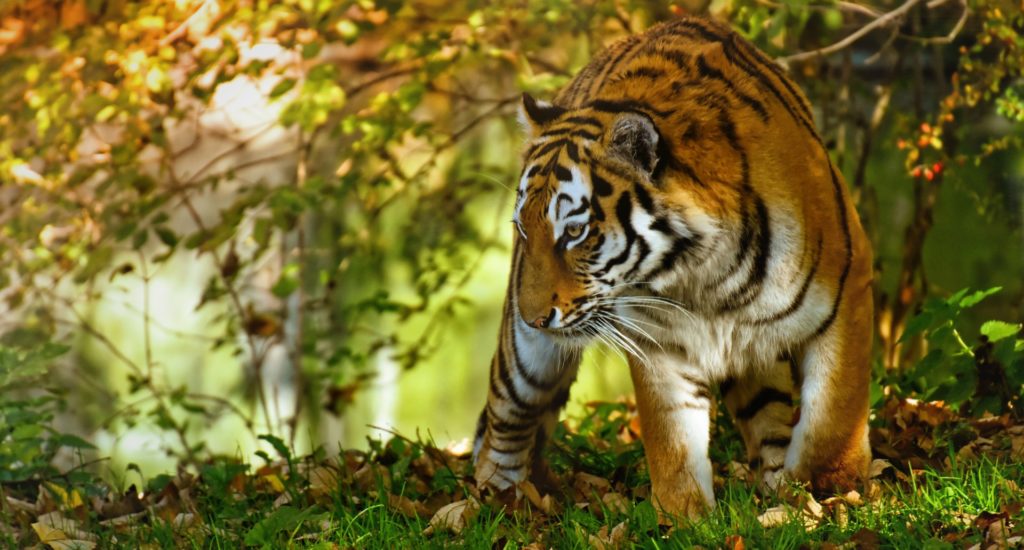
Scientists have used an online game to discover the secrets of animal camouflage – such as why tigers have stripes.
The study, by the universities of Exeter and Bristol, reveals that high-contrast markings like tiger stripes are harder to see in sunshine, and in complex 3D habitats such as tall grass or forest undergrowth.
Meanwhile, plainer markings provide better camouflage in indirect sunlight (e.g. under clouds or tree cover) and in simple habitats like short grass.
The results come from a game designed by University of Exeter scientists and played by over 1,000 people. In the game, a patterned sphere “evolved” to become harder to find against various backgrounds and lighting conditions.
“Human vision overlaps with that of many predatory species, so our game is a powerful way to investigate complex questions that are hard to assess in wild animals,” said Dr George Hancock, from the Centre for Ecology and Conservation at Exeter’s Penryn Campus in Cornwall.
“In the game, camouflaged spheres ‘evolved’ over 20 generations, based on how long it took players to find them.
“If a sphere took longer to find, the game used that information to help design the next pattern by combining pairs of the best patterns together.
“In effect, our study used digital evolution to help us understand real-world evolution.”
The background photos where the spheres had to “hide” came from 28 habitats of varying 3D complexity across the UK, pictured in both direct and indirect sunlight.
Under direct sunlight, spheres developed more high-contrast, dark and stripey patterns, countershading (paler underneath like a tiger, antelope or great white shark) and edge disruption (making it harder to see the animal’s outline).
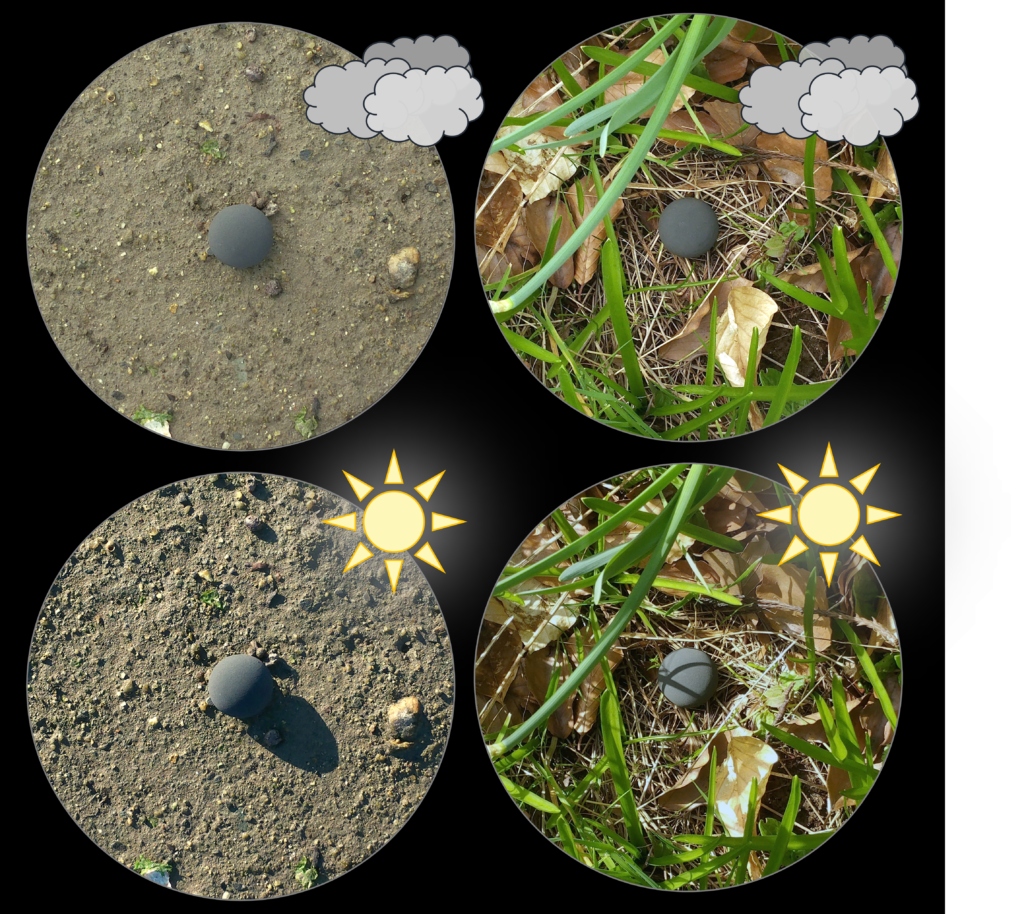
Dr Hancock said: “We examined something everyone knows but doesn’t think about too often: the fact that the world looks very different on a sunny day.
“When the sun comes out, shadows make the background more visually complex and directional.
“The shadows are stronger and even more directional when the environment is more 3D, such as when there’s taller vegetation.
“This explains how tigers got their stripes: they match the stripe-like shadows within their environment – and similar patterns evolved within our game.
“Equally, plainer patterns – such as those of roe deer – provide better camouflage in places with less direct sunlight and visually simpler habitats.”
Dr Hancock added that many predators are known to be highly active at dawn and dusk – when long shadows create extra visual complexity.
Dr Jolyon Troscianko, also from the University of Exeter, said: “Camouflage is essentially a tug-of-war, with both predators and prey investing in various strategies depending on their behaviour and environment.”
The researchers say that changes to habitats and lighting – including from land management, urbanisation and climate change – could alter the subtle costs and benefits of different camouflage strategies.
“It’s important to understand how such changes might influence animal survival – particularly for species that may already be under threat,” Dr Troscianko added.
The study was funded by the Natural Environment Research Council.
The paper, published in the journal PLOS One, is entitled: “Shining a light on camouflage evolution: using genetic algorithms to determine the effects of geometry and lighting on optimal camouflage.”