Poetry expert reconstructs the lost verse of Jacob Bronowski
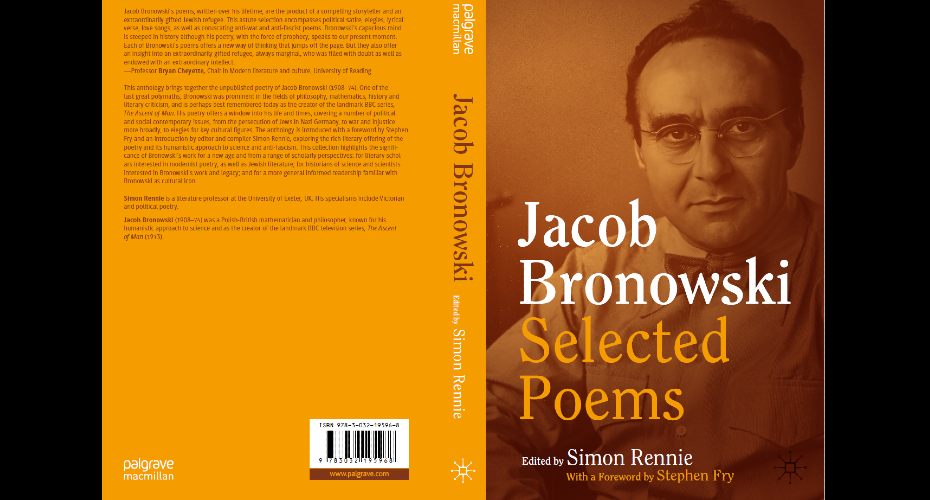
A groundbreaking new book that unearths the poetry of legendary polymath Jacob Bronowski has been published thanks to the remarkable research efforts of a University scholar.
Professor Simon Rennie – a renowned expert on Victorian verse – has spent years studying the manuscripts of Jacob Bronowski in a bid to bring his poetry into the public realm for the first time.
Prominent in the fields of mathematics, philosophy, literary criticism and history, Bronowski is perhaps best remembered as the creator of the landmark BBC series, The Ascent of Man, broadcast in 1973. But potted histories of Bronowski also refer to his poetry, despite very little of it having reached the public domain.
Now, with the publication of Jacob Bronowski: Selected Poems, by Palgrave Macmillan, that missing element of his biography has been reconstructed by Professor Rennie.
“Bronowski’s groundbreaking TV series The Ascent of Man remains a touchstone for quality intellectual filmmaking,” said Professor Rennie, of the University of Exeter’s Department of English and Creative Writing. “But his poetry has proven to be elusive, beyond a few examples online. These are typically well-regarded, but his unread works, even those published in obscure modernist magazines nearly 100 years ago, reveal a greater depth to the thinking of this renowned philosopher of science and humanities.”
Bronowksi’s papers are held in an archive at Jesus College, Cambridge, and this is where, in 2021, Professor Rennie found more than 100 poems in various textual states, and most of them unpublished. Many had been revised by Bronowski, often decades later, with some torn from their original publication and amended by hand.
By cross-referencing with the author’s notes and assiduous date-keeping, and learning to read Bronowski’s handwriting, Professor Rennie was able to painstakingly reconstruct the poems.
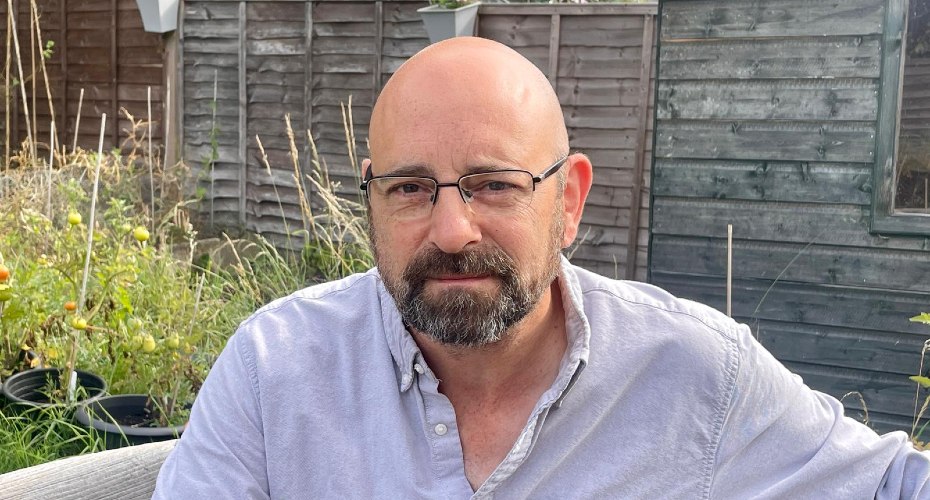
“I took the decision to present the poetry, as far as possible, in the order it was composed,” he said. “This also grouped it stylistically, which is particularly important for the works written during the Spanish Civil War, the rise of fascism in Europe and the period of tension before the Second World War.”
Bronowski held numerous senior roles in British society, including head of research at the National Coal Board, and one of the mathematicians involved in Strategic Operations during the War. He was part of the British scientific team that examined the effect of the Hiroshima and Nagasaki atomic bombs, and first became known to the public in the late 1940s on the BBC Radio programme, The Brains Trust.
These biographic details are captured in Professor Rennie’s extensive introduction in the book, along with a foreword from Stephen Fry. And through its publication, Professor Rennie has realised not just a significant literary achievement, but also a personal one. It was meeting his new partner in 2019 – the granddaughter of Bronowski – that prompted the first discussions concerning the whereabouts of his poetry. Seven years on, the answer has been revealed.
“For those who remember Bronowski as a cultural figure and broadcaster, I hope this book helps to complete the picture of a complex and brilliant man,” Professor Rennie adds. “For readers coming to Bronowski for the first time, I think this will open access to a significant poetic voice and an important addition to the story of British modernist verse.
“In addition, and perhaps as important, readers can reflect on the warnings the poetry contains in relation to the politics of division, hatred, and war, and consider the relevance to today’s political situation across the world.”
For more details, visit the Palgrave Macmillan website.