
‘Huge step’ for European Solar Telescope as ESFRI Landmark status granted
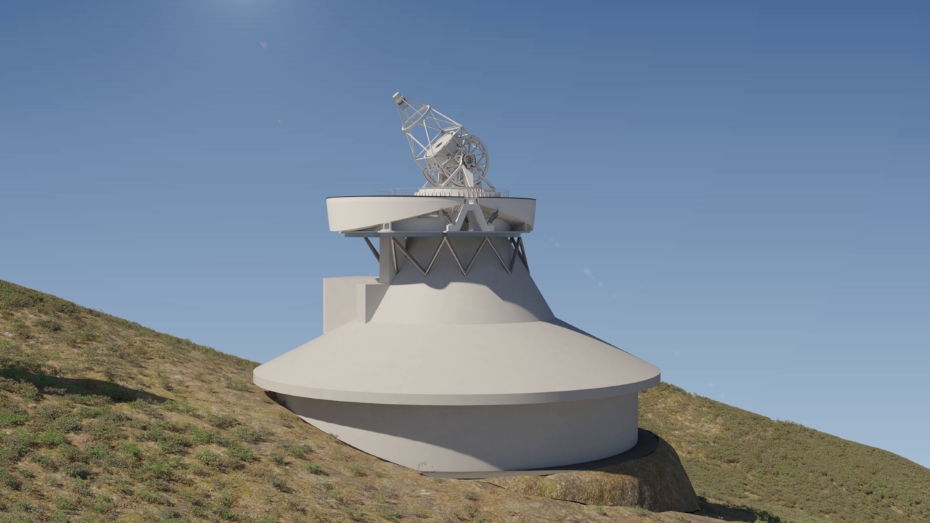
A representation of what the European Solar Telescope will look like. Credit: IDOM
The European Solar Telescope (EST) has taken a ‘huge step’ in bringing scientists closer to studying the sun in unprecedented detail after it was granted landmark status.
Granted by the European Strategy Forum on Research Infrastructures (ESFRI), the new landmark status recognises EST’s progress towards construction, its scientific ambition and the role it is expected to play within Europe’s research infrastructure landscape.
The University of Exeter is among a group of UK institutions contributing to EST through the UK Universities Consortium (UKUC), which brings together researchers and institutions from across the UK and is led by the University of Sheffield.
Professor Andrew Hillier, Co-Director of the Exeter Centre for Mathematical Sciences, said: “EST achieving landmark status is a huge step for the project. Given the work we do at Exeter to build cutting-edge models of the solar atmosphere, EST would provide the exact observations we need to constrain and improve our models. I’m really looking forward to contributing to the next stages of development to help this project become a reality.”
ESFRI Landmarks are research infrastructures that are already operating or have reached an advanced stage of implementation.
Professor Robertus Erdélyi, from the Solar Physics and Space Plasma Research Centre (SP2RC) at the University of Sheffield and Coordinator of UKUC, said: “Reaching this milestone is the result of years of excellent work by many people and institutions in the UK and across Europe.”
The EST will be built at the Roque de los Muchachos Observatory in La Palma, Spain, and brings together institutions from across Europe, coordinated by the EST Foundation, with strong support from the IAC (Instituto de Astrofísica de Canarias).
Once built, EST will give astronomers an unprecedented view of the sun and the processes that shape its atmosphere and influence the near-Earth space environment.
By providing detailed observations from the ground, EST will complement observations from space missions and provide crucial data to help researchers understand solar phenomena that can affect space weather.
Its 4.2-metre-class mirror and advanced instruments are designed to observe the solar atmosphere at multiple heights simultaneously and across different wavelengths.
This will allow researchers to follow the emergence and evolution of magnetic fields at the solar surface and investigate how energy is transported through the solar atmosphere.
These processes are fundamental to understanding solar activity, including the mechanisms that drive solar eruptions. The sun is the only star whose surface and lower atmosphere can be observed in such detail, making it a unique laboratory for studying fundamental physical processes.
EST will provide observations at scales and levels of detail that complement those possible from solar space missions. Together, ground and space-based observations will help researchers build a more complete picture of how the sun works.
The ESFRI Landmark status represents an important step towards making that capability a reality and strengthens the case for EST as a major European research infrastructure for the coming decades.
Héctor Socas-Navarro, Director of the EST Foundation, added: “Becoming an ESFRI Landmark is a major milestone for EST. It is a recognition of the European relevance of this research infrastructure. The EST community has built, over many years, a remarkable European collaboration around a common scientific goal. Landmark status recognises the maturity and strategic relevance that the project has now reached within the European research infrastructure landscape.”