Morocco’s new government
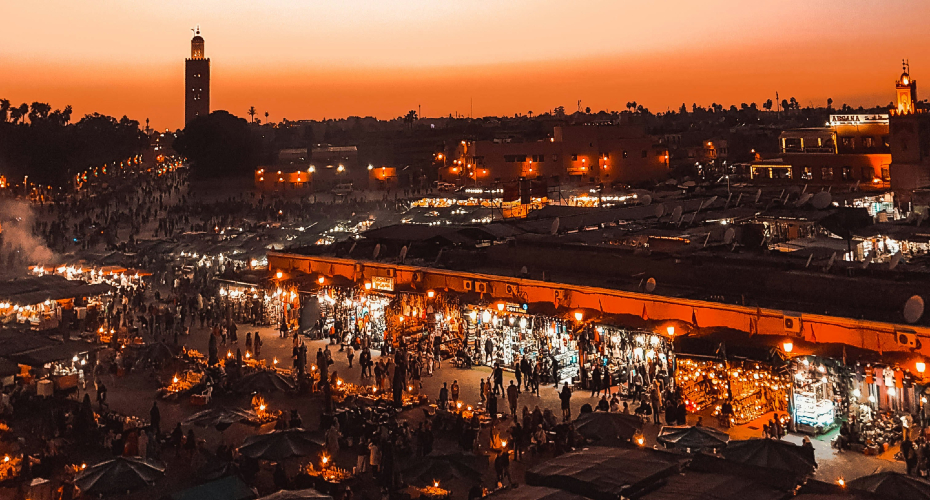
Marrakech at night: Photo by Miltiadis Fragkidis on Unsplash
Commenting on Morocco’s new government, Dr Irene Fernandez-Molina, an expert in the region and Senior Lecturer in International Relations in the Department of Social and Political Sciences, Philosophy, and Anthropology, said:
“Two headlines have dominated coverage of last week’s parliamentary election in Morocco: a two-decade low turnout and King Mohammed VI’s appointment of a women as prime minister for the first time in this country’s history. The latter cannot be understood without the former.
“The official turnout rate is 38%, but this percentage is calculated based on the number of registered voters (15.8 million) – as Morocco is a country where one must register before each election to exercise the right to vote. If we consider the total number of people eligible to vote in the country (between 27 and 28 million), the actual turnout would be approximately 22%. This is an extremely low figure, revealing and posing problems for both the regime’s domestic legitimacy and its international image. That is why I believe the King has opted to appoint a woman, Fatima Ezzahra El Mansouri, to lead the next coalition government. This appears to be a clear case of authoritarian state feminism – a top-down, selective instrumentalisation of the struggle for women’s rights for regime legitimation purposes.
“Authoritarian state feminism has a long trajectory in the Middle East and North Africa. Press reports have stated that El Mansouri is the second woman to hold the office of PM in an Arab country. In reality, she is the third, as Tunisia has had two female PMs in recent years, Najla Bouden between 2021 and 2023, and Sara Zaafarani at present. What is noteworthy is that both Bouden and Zaafarani were appointed by the Tunisian President Kais Saied in a context of democratic backsliding or autocratisation. This highlights the illusion we risk falling for if we automatically assume that appointing a female PM signifies progress for women’s rights, or for the liberalisation and democratisation of a political system like Morocco’s.
“In terms of her profile, El Mansouri has a 20-year track record in public management and politics, particularly at the local level as mayor of Marrakesh, but also more recently in parliament and government. She is also the embodiment of the Moroccan elite and establishment, hailing from a prominent family in Marrakesh and having entered politics at the invitation of Fouad Ali El Himma – a close friend of the king who in 2008 founded the Authenticity and Modernity Party (PAM) as an ally of the palace in parliament and government.”