
New research project to analyse royal documents at the dawn of medieval Europe
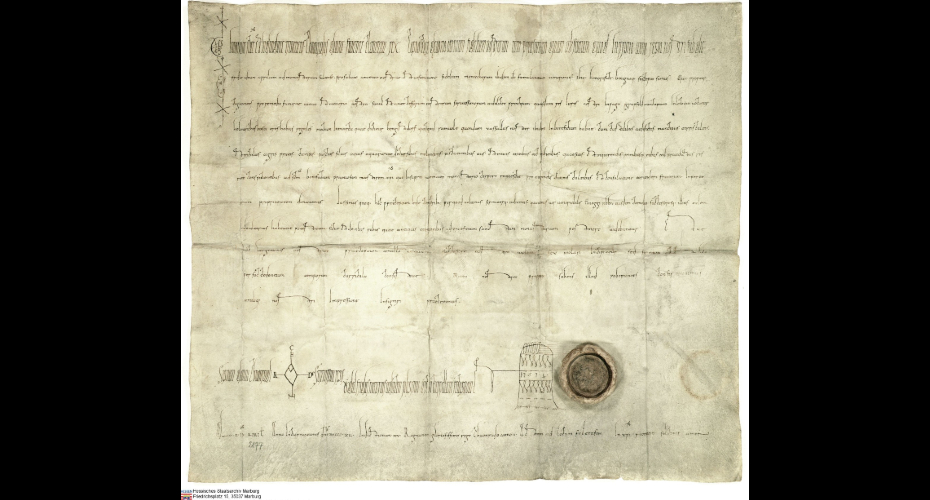
A charter of Conrad I from 12 April 912. Marburg, Hessisches Staatsarchiv, Urk. 75, 60
A transformational era of European history that heralded the emergence of distinct kingdoms of France and Germany is to be the focus of a new international research collaboration.
Historians will examine and transcribe royal documents issued by Conrad I (911-918) and Henry I (919-36) to develop a greater understanding of life in the early years of the emerging German kingdom.
Few contemporary documents survive from this period of the tenth century, and this has contributed to it being relatively under-researched compared to the eras immediately preceding and following it.
Of the sources that do survive, however, royal charters – also known as diplomas – provide a wealth of potential insight, because they were used to communicate and effect political and religious change. They also reflected not only the king’s interests, but also those of recipients and third parties.
The project team at the University of Exeter and Monumenta Germaniae Historica in Munich will visit 22 archives across Europe and Britain to study their collections of charters and create an open-access digital edition and research tool.
“The early tenth century is a pivotal period in European History,” says Professor Levi Roach, project lead at the University of Exeter, and an expert in early German history. “It is in these years that medieval Germany, France and Italy begin to emerge, creating political and cultural divides that endure to the present day.
“Our project will shed important new light on these processes, editing the diplomas to modern scholarly standards for the first time. This will offer fresh insights into these crucial political transformations, and shed light on ecclesiastical culture, legal custom, local landholding and much more.”
Professor Roach said the two kings represented a break from the Carolingian dynasty, which had dominated continental Europe since 751, most notably through the rule of the famous emperor Charlemagne (768–814). But a relative lack of surviving contemporary narratives and records has hampered historians wishing to research their combined 27-year rule.
Over the lifespan of the project, 84 charters will be examined and, using UV lighting and other modern techniques, checked for signs of alteration and erasure. The team will measure the documents, transcribe the Latin text, and describe other visual features.
“These were stately, expensive documents, copied on parchment (treated animal skin) with lavish spacing and elongated lines of text in the first and closing lines,” says Professor Roach. “They contained signatures, the royal monogram representing the monarch, and the royal seal – all of which would have been deeply symbolic to readers who might not have understood the Latin text.”
The Monumenta Germaniae Historica, a leading centre for the editing and studying of medieval texts, will help establish and maintain the digital edition, which will be hosted on its website. By including the texts of all surviving witnesses and images of all original documents, as well as expert commentary, the resulting editions promise to be extremely valuable research tools, not only for scholars of the period, but also for those studying similar documents from other eras.
“This is a unique opportunity to examine in detail these essential sources and open them up for serious study,” adds Professor Roach of Exeter’s Department of Archaeology and History. “We hope these new editions bring this historical field firmly into the twenty-first century, with implications well beyond the history of East Fancia.”
Charting Authority after Empire: The Diplomas of Conrad I and Henry I will run for the next two and a half years and is being funded by a grant of nearly £350,000 by UKRI in the UK and €193,200 by the DFG in Germany.