Earth Rover Program launches globally on World Soil Day
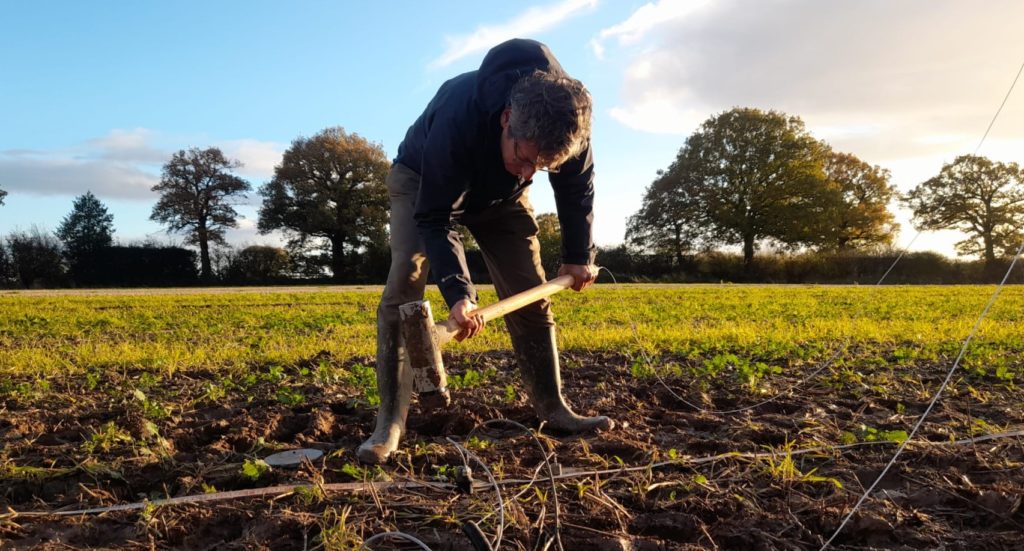
An Earth Rover Program team member conducting seismic wave sampling. Credit Earth Rover Program
The Earth Rover Program launches globally today (World Soil Day), unveiling “soilsmology”, which promises greatly to improve our understanding and use of one of the world’s most crucial resources – soil.
By using the well-established methods of seismology in novel ways, the Earth Rover Program enables us to “see” into the shallowest layers of the soil, revealing its vital signs with unprecedented clarity.
Launched with support from the Bezos Earth Fund, the Earth Rover Program – co-founded by Professor Tarje Nissen-Meyer from the Department of Mathematics and Statistics, University of Exeter – began as a bold proof-of-concept to make soil health visible, measurable, and actionable.
Two years later, it is a functioning global network poised to transform how we manage soil – one of the planet’s most vital, and vulnerable, ecosystems.
The Earth Rover Program has already shown that ultrahigh-frequency waves can be used for seismic analyses of topsoil, producing exceptionally high-quality data with extremely fine resolution (10cm).
It has already demonstrated an ability to map crucial properties such as soil volume and bulk density, both of which are difficult and expensive to measure, and extremely hard to scale by other means. It has also been able to detect the impact of different farming practices on soil and to track soil moisture.
Measurements have now been taken, with identical field setups, in Europe, Africa, and South America. In all cases, they have produced high-quality data, enabling the differentiation of various ecosystems and agroecological zones.
The Earth Rover Program’s intended next steps include combining seismology with its new sensor design and AI model to enable fast, affordable, and scalable soil health monitoring; working on the seismic mapping of soil moisture at depth; measuring connected porosity (a crucial metric of soil health); and determining soil texture and soil carbon.
By rapidly reducing the cost and complexity of the new tools, the Earth Rover Program should allow anyone, including the world’s poorest farmers, to achieve a near instant view of the health and properties of their soil.
Just as the Human Genome Project revolutionised medicine by decoding the human body, so the mapping of the planet’s soils will transform our understanding of the ground that sustains us, creating a shared, trusted source of knowledge for the benefit of people and planet.
Over the course of two years of research and development, the Earth Rover Program has reduced the cost of the seismic sensors used for this purpose from $1,000 each in 2023 to $10 today, through its next-generation MEMS accelerometer. It hopes to reduce the cost to $1 soon.
This transformative approach involves passing ultrahigh-frequency seismic waves through the topsoil and subsoil to map soil volume, internal interfaces, and bulk density without disturbing the soil. These properties, and others such as moisture, connected porosity, and soil carbon – all of which can, in principle, be detected with these techniques – are key determinants of soil health and crucial metrics for farmers. They have been extremely challenging and costly to study at scale using existing methods.
As the Earth Rover Program’s new technology is “non-invasive”, it avoids a major problem faced by soil scientists: traditional soil sampling, which involves digging or taking core samples, disturbs the very structure it seeks to study. The Earth Rover Program’s tools are much cheaper, faster, and easier to deploy than existing methods, making soil monitoring accessible to everyone and opening the door to a global citizen-science movement in which people upload their results and collectively build a vast, self-improving database based on open-source, encrypted and trusted data pipelines.
Professor Nissen-Meyer said: “As a geophysicist, soil was always just that layer we had to look through, somewhere between dirt and invisible. Coming to realise that this is arguably the most vital terrestrial ecosystem for life on Earth – on which our food, carbon cycle, and water quality depend entirely – has been a scientific and conceptual revelation for me personally.
“Understanding soils is as scientifically difficult as it is societally relevant and urgent. The Earth Rover Program, working closely with the University of Exeter, attempts to address this challenge in its holistic complexity.
“The scale of the challenge we face can seem overwhelming, intersecting complex systems with seismic inversion, ecologically responsible engineering with farmer livelihoods and cultures, field sampling in extreme conditions around the world’s ecosystems with modern AI and data science.
“But I feel profoundly privileged and lucky to be involved both at Exeter and Earth Rover Program, collaborating in fantastic, stimulating interdisciplinary environments with friendly and passionate colleagues, not the least being integrated with the new Center for Environmental Intelligence.
“This inspires us to leap forward to hopefully make a difference for others, especially those that are less privileged and not responsible for some of our self-inflicted ecological crises: marginalised communities around the world, non-human life and future generations in particular.”
As one of two Executive Directors, Professor Nissen-Meyer leads Earth Rover Program’s science team in seismology, geophysics, sensor engineering and AI. Earth Rover Program’s core sensor development takes place at Exeter through Dr Jiayao Meng along with Dr Ki Koo in the Department of Engineering, with further collaborations emerging in dynamical systems, peatlands, climate science, and uncertainty quantification.
A global challenge: Seeing beneath the surface
Soil provides 99% of the calories we consume and holds more carbon than the atmosphere and vegetation combined. Yet 75% of the world’s soils are degraded. This degradation threatens food security, ecosystems, and climate stability; crop yields are projected to fall by up to 50% by 2050 in vulnerable regions, with the potential to displace millions of people if action is not taken.
The Earth Rover Program bridges critical knowledge gaps through open-source, AI-integrated, and globally collaborative research between scientists, farmers and other stakeholders, providing the tools needed to transform our relationship with this crucial resource.
Applying “soilsmology” for real-world impact
Working with partners in the UK, Kenya, Colombia, and Germany, and conducting further surveys in France, the Earth Rover Program is applying “soilsmology” to a wide range of soils and agricultural contexts, marking the first steps in establishing a global database. The near-instant insights it offers will help remove the guesswork from farming, enabling farmers worldwide to reduce inputs such as fertiliser, irrigation, and deep tillage without sacrificing productivity. They will help us achieve the elusive “Holy Grail” of farming: high yields with low impacts.
Using AI for good: looking to the future
Along with these applications, the Earth Rover Program has developed its ERP-GPT platform to translate complex soil data into clear, actionable guidance for scientists, farmers, and policymakers worldwide. Its long-term goal is to develop the world’s first soil forecast, or “soilcast,” enabling an analysis of soil health trends akin to weather forecasting, which will guide the decision-making of community growers, research institutions, government agencies, small and large farmers, and other land managers.
George Monbiot, co-founder of the Earth Rover Program, said: “For too long, soil has been dark to us. This is the ecosystem, above all others, on which our lives depend; yet, despite the brilliant work of many soil scientists, our understanding is still alarmingly patchy. The Earth Rover Program changes that. Equipped with a far richer knowledge of their own soil, its qualities, health and deficiencies, farmers can reduce environmental harm while sustaining or enhancing their yields. In time, we hope, the Earth Rover Program will help enable new approaches to biological improvement of the soil, further reducing the need for chemical augmentation. The result could be something I’ve long wanted to see: consistently high-yielding agroecology. Then we can feed the world without devouring the planet.”
Dr Andy Jarvis, Director of Future of Food at the Bezos Earth Fund, said: “Anyone who’s ever dug a soil pit knows how hard it is to understand what’s happening below the surface. The Earth Rover Project team found a way to read that hidden world without tearing it apart, and that opens possibilities we simply haven’t had before. The Earth Fund backed this work because better soil knowledge strengthens everything we care about in climate and nature. What’s emerging now is a practical way for farmers and scientists to see their soils clearly and act with confidence.”
Professor Jacqueline Hannam, Professor of Sustainable Agriculture and Biodiversity and Head of Agriculture, Health and Environment Department of the Natural Resources Institute, University of Greenwich, who last year was President of the British Society of Soil Science, and is not connected to the Earth Rover Program, said: “It’s really challenging to know what’s going on underneath our feet. Methods developed by the Earth Rover Program have enormous potential to see beneath the surface and, importantly, quantify soil properties such as soil depth, bulk density and water movement. This breakthrough, using new ways of deciphering seismic signals, can achieve this without having to put a spade in the ground. The data generated are urgently needed to reverse soil degradation and inform sustainable soil management.”
The Earth Rover Program will release its inaugural flagship report, ‘Soilsmology: Transforming our Understanding of Soil’, during a virtual webinar on 5 December 2025. The webinar will feature opening remarks from Kate Raworth, and the event will feature a panel discussion with the Earth Rover Program’s co-founders and Franciska de Vries, Professor of Earth Surface Science at the University of Amsterdam. Access the report by visiting www.earthroverprogram.org/