
Master of the Rolls outlines need to prepare for AI-created “turning point” for justice delivery at law teachers’ conference in Exeter
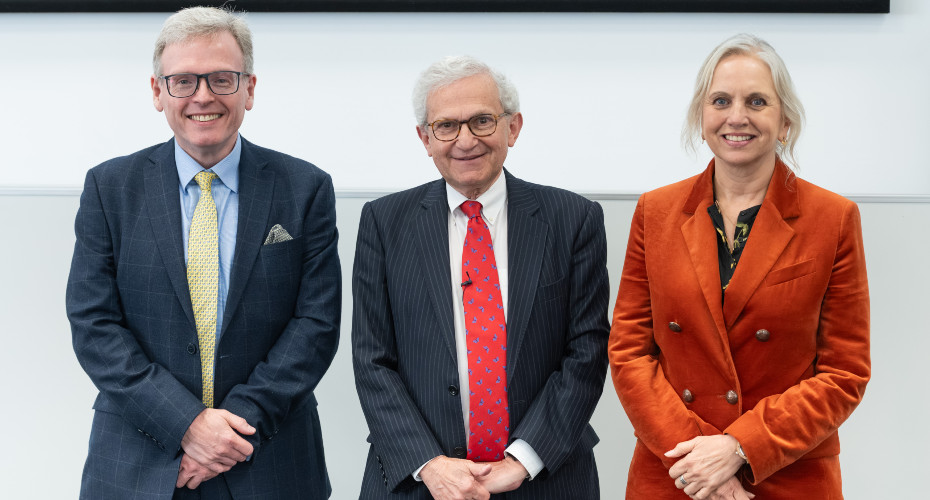
Professor Mark O'Brien, Chair of the Association of Law Teachers, Sir Geoffrey Vos and Kirsty Brimelow KC
The growth in use of AI means delivery of justice in England and Wales is at a “turning point”, and it is incumbent on law schools and lawyers to prepare for what lies ahead, the Master of the Rolls has said.
Sir Geoffrey Vos, Master of the Rolls and Head of Civil Justice for England and Wales, was a keynote speaker at the Association of Law Teachers Annual Conference 2026 at the University of Exeter in April, alongside Kirsty Brimelow KC, Chair of the Bar Council of England and Wales, who spoke about protest rights and academic freedom.
The conference, ‘Reimagining Legal Education for the Future of Law’, was co-chaired by Exeter Law School academics Dr Louise Loder and Dr David Yuratich, and included key discussion sessions on employability, skills and the future and the impact of AI on teaching practice, integrity and curriculum and assessment.
Sir Geoffrey said those who suggest that lawyers will not be needed in the machine age are wrong, but new technology means their job will change. Humans will remain instrumental in guiding and assisting other humans towards the understanding and acceptance of machine-made decision-making.
Sir Geoffrey said the current trend of people seeking legal advice through AI, and then asking lawyers to confirm what they have found and not expecting to pay the same fees, is already leading to reduced law firm recruitment. And, where law firms are recruiting, they are looking for different skill sets – people who can lead and guide both tech-savvy and tech-sceptic clients through the minefield of AI-driven justice.
He told attendees that ethics in law schools will need to be taught through a new lens, and an understanding of data protection and data security is now far more fundamental. The skills of lawyers and judges to be able to spot fakes generated by AI, and to be able to spot fake allegations that genuine materials are AI fakes, are more critical now than ever before.
Sir Geoffrey said: “As I see it, the greatest change will be in what individuals and businesses expect from the law and the justice system. They will no longer value lawyers in the same way because they will have their own access to the previously forbidden land of laws and legal precedents. All that will be available, much of it free of charge, by the use of AI driven tools. Instead, they will value the guidance and insight that trained lawyers can give to explain what the machines have advised and, perhaps also, determined.”
Sir Geoffrey has served as Master of the Rolls since January 2021. He presides over the Civil Division of the Court of Appeal and chairs the Civil Justice Council, the Civil Procedure Rule Committee and the Online Procedure Rules Committee.
In her keynote, ‘Whose Freedom? Law, Power, and Social Justice’, Kirsty Brimelow KC talked about the legal contours of the right to protest under the Human Rights Act 1998 and the common law, exploring the specific context of academic freedom and the roles that law teachers can play in helping future lawyers navigate that dynamic relationship between law, power and social justice.
In their keynotes, Professor Richard Moorhead, Professor of Law and Professional Ethics at the University of Exeter, spoke about the lessons learned from the Post Office Project, major research to track the impact of the scandal on those affected and the role that lawyers may have played in any miscarriage of justice; and Kirsten Maslen, Senior Director of Growth & Commercial Strategy at Thomson Reuters, explored how we might preserve legal thinking and reasoning in education and training in the age of AI.
The two-day conference programme welcomed law teachers from universities around the UK as well as from Ireland, the Netherlands, Finland, Poland, Norway, Nigeria, India, Saudi Arabia, Singapore, Hong Kong, New Zealand and Australia – both in person and online. Across 27 sessions, academics presented research and ran workshops on subjects including partnership and belonging, clinical legal education, AI in legal education, and curriculum design. Panels hosted by BARBRI and Thomson Reuters examined the impact of the introduction of the Solicitors Qualifying Examination, five years on; and how legal education can respond by embedding AI literacy while preserving the intellectual foundations of legal study.