New digital tool to be launched at World Economic Forum that calculates impact of websites on nature
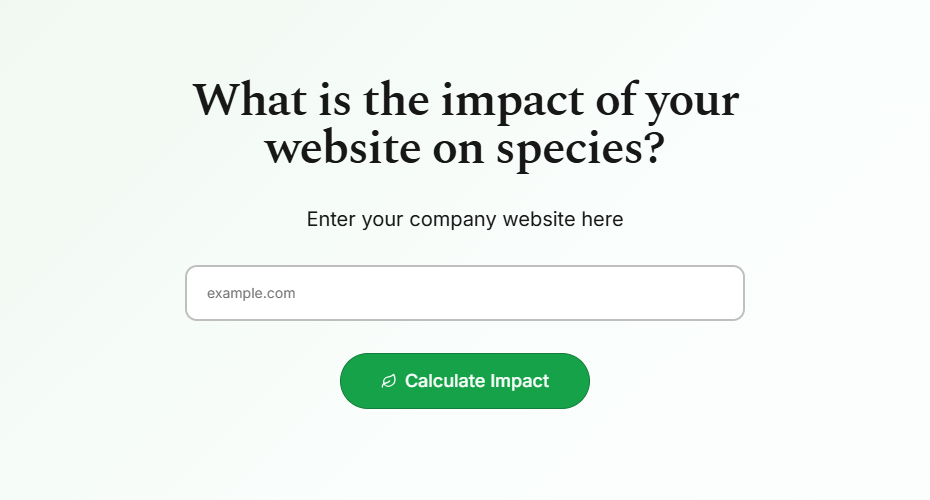
A new digital tool that calculates the environmental footprint of websites in engaging nature-focused terms is to be launched this week.
Digital Impact for Species can analyse any website and reveal its hidden environmental costs beyond standard carbon dioxide emissions, water and energy consumption.
Developed by climate experts at the University of Exeter, in partnership with Madeby.studio, the tool translates this footprint into the equivalent impact on animals, plants and trees.
It will be launched at the World Economic Forum in Davos, where attendees will be invited to input their websites and obtain their results instantly.
“When we visit a website, we rarely think about the environmental impact,” says project lead Dr Marcos Oliveira Jr., a Research Impact Fellow in Exeter’s Nature and Climate Impact Team. “But there is a high cost, from the energy consumed as the information makes its way from the data centre to your computer or smartphone, to the water used to cool servers.
“So, the focus of Digital Impact for Species is to make visible the hidden environmental footprint of digital actions, and to communicate that more tangibly, moving away from abstract terminology and towards relatable comparisons that connect on an emotional level.”
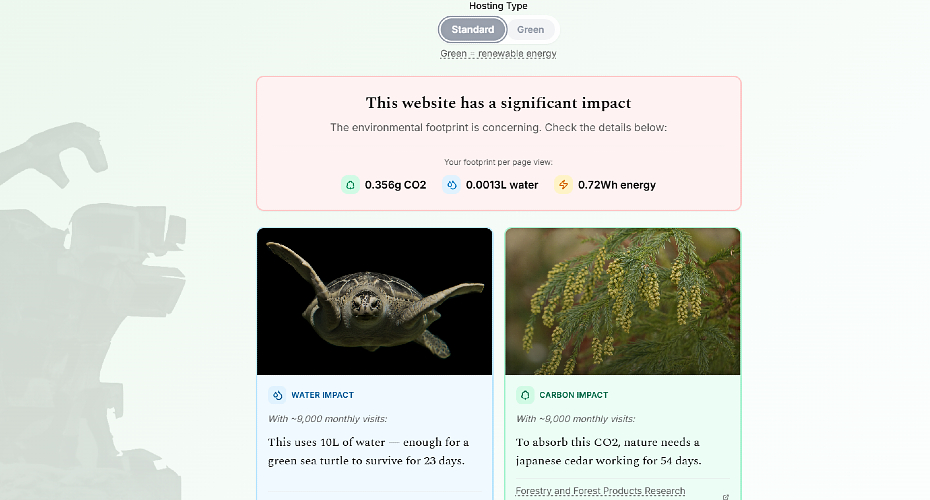
Digital Impact for Species measures the size of each website, including images, scripts and stylesheets. It searches the Green Web Foundation to determine if the site is hosted on servers powered by renewable energy, before using a bespoke tool to express the level of emissions in relation to trees and plants; water consumption on the daily needs of various animal species; and energy consumption on pollinators and small creatures.
The work has been part-funded by UKRI’s impact acceleration accounts, and was created for MonkeyRock, the large-scale art installation and public stage that will serve as a ‘species corner’ at Davos. The eight-metre sculpture of a great ape was conceived by Joep van Lieshout (Atelier Van Lieshout) and Gail Whiteman, Professor of Sustainability at the University of Exeter Business School and leader of NCIT. It will be the focus of numerous talks and performances during the WEF.
Representatives from the project team will be at the Climate Hub with QR codes for people to access the tool and input their websites. Users will then be able to download a best practice guide for green web design.
“By aligning with MonkeyRock, we will invite Climate Hub participants to reflect on the hidden environmental costs of our digital lives,” adds Dr Oliveira jnr. “This is not about naming and shaming websites with high environmental footprints, but engaging people and prompting discussion as to how we might build a more sustainable internet.”
For more information, visit the Digital Impact for Species website.