
Global warming must peak below 2°C to limit tipping point risks
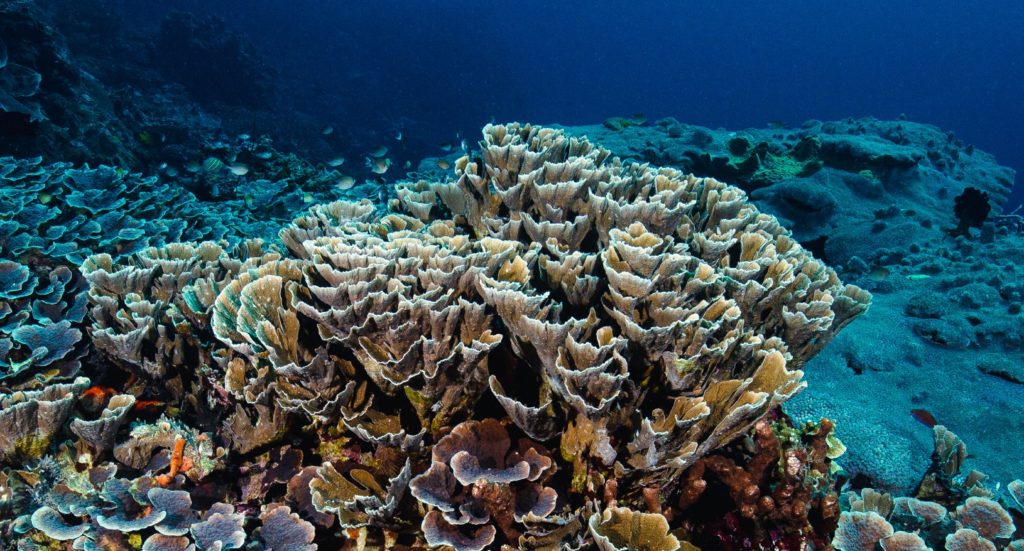
Earth systems at risk of tipping include the dieback of tropical coral reefs. Credit Prof Peter Mumby
Global warming must peak below 2°C then return under 1.5°C as quickly as possible to limit the risk of dangerous “tipping points”, experts say.
The new paper, by an international team of researchers, reviews the latest evidence and says global temperatures must cool to around 1°C above pre-industrial levels in the long term.
A tipping point defines when a small change in environmental conditions can spark a transformation that can be rapid and is often irreversible.
Earth systems at risk of tipping include the dieback of tropical coral reefs and the Amazon rainforest, and the melting of permafrost and major ice sheets on Greenland and Antarctica.
Such tipping events could have devastating consequences for people and nature and could rapidly accelerate climate change – leading to further tipping events.
The new review – which builds on a chapter of the 2025 Global Tipping Points Report – warns that up to eight tipping points could be reached below 2°C warming.
The research was led by the University of Exeter, the Potsdam Institute for Climate Impact Research (PIK) and the Centre for International Climate Research (CICERO).
“It is increasingly likely that global warming will exceed 1.5 °C in the late 2020s or 2030s,” said lead author Dr Paul Ritche, from Exeter’s Global Systems Institute.
“The tipping point for several Earth systems could therefore be crossed – at least temporarily.
“However, tipping does not occur immediately upon crossing a tipping point.
“If we limit the maximum level of warming, and keep the duration of the overshoot short, tipping could still be avoided for many tipping elements of the Earth system.”
Dr Ritchie explained that some systems – such as tropical coral reefs – respond very quickly to higher temperatures and are therefore especially vulnerable to “overshoots”, even when they are short.
With current global warming at about 1.4°C, warm-water reefs are passing their thermal tipping point (central estimate 1.2°C, range 1-1.5°C). This means coral reefs on any meaningful scale will be lost unless the global temperature returns towards 1°C warming or below very quickly.
In contrast, potential tipping points with slower response times – such as polar ice sheets – may be less sensitive to temporary overshoot.
“Therefore, we need to develop a proper risk assessment for tipping elements,” said study co-lead author Nico Wunderling from PIK and Goethe University Frankfurt.
“This paper begins that work, but more is urgently needed.
“It’s concerning that, even with a small and relatively brief overshoot of the 1.5°C target, up to five Earth system tipping points could be triggered.
“Like an individual assessing the risk of a house fire or a plane crashing, we can’t simply plan based on a ‘best guess’ – we need to anticipate the dangerous outcomes and take action to prevent them.”
The researchers say that “additional human pressures” – such as deforestation in the Amazon or pollution and overfishing of coral reefs – can lower their temperature tipping points.
Norman Steinert, co-lead author from CICERO, concluded: “Minimising the peak of an overshoot is crucial, but arguably minimising the duration is even more important.
“However, it’s important to note that these things are related: the higher the peak temperature, the more difficult it is to reverse temperature below critical levels and the longer it’s likely that we’ll remain in ‘overshoot’.”
The paper, published in a special issue of the journal Environmental Research Letters, is entitled: “The implications of overshooting 1.5°C on Earth system tipping elements – a review.”