
Lost seal of Edward the Confessor found after being missing for 40 years
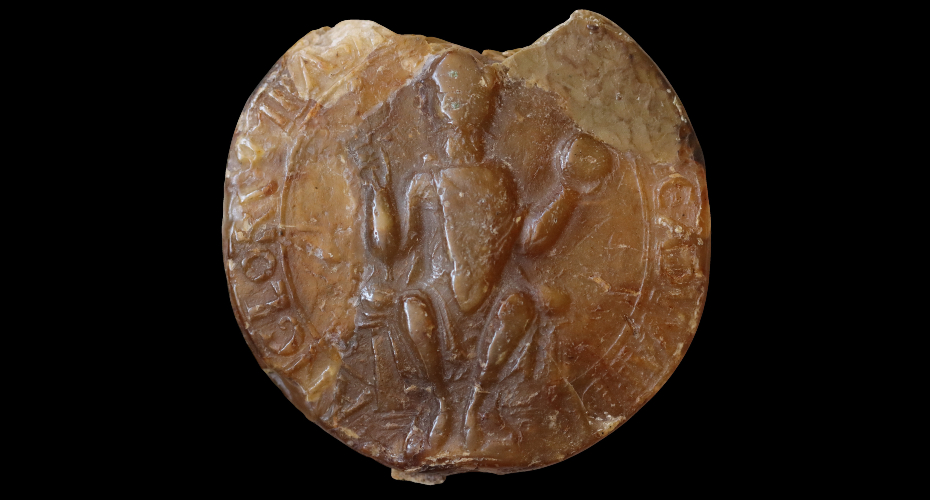
Saint-Denis Seal Impression of Edward the Confessor (1053 × 1057). © Paris, Archives nationales, Sc/x/832.
An 11th-century Anglo-Saxon seal belonging to Edward the Confessor has been rediscovered more than 40 years after being declared lost.
The wax impression of the ‘Saint-Denis seal’ disappeared without official explanation in the 1980s from the Archives Nationales in Paris, where it had resided for almost 200 years.
By far the best-preserved impression of the three seals known to have been used by Edward, its loss sparked great consternation among international historians.
But it has now emerged that the wax artefact was found by a curator and a PhD student conducting research in a section of the Paris archive that contained a collection of detached and damaged seals.
This rediscovery, in 2021, has been revealed for the first time in a new academic paper co-authored by the finder, Dr Guilhem Dorandeu, and Professor Levi Roach, of the University of Exeter.
In the article, published in the journal Early Medieval England and its Neighbours, the historians say the seal, and the document with which it was used, demonstrates that the last Anglo-Saxon King of England consciously drew upon Byzantine and European influences in this aspect of statehood.
Dr Dorandeu said: “Pendant seals were two-sided wax impressions that were attached to a document by a cord or ribbon, which hung below it. Historically, these were used by monarchs to authenticate and approve important state papers.
“Edward’s seal is, therefore, a precious historical monument, and its recovery offered us a great opportunity to study it closely and consider what it says about the ambitions and influences swirling around the King and his advisors.”
Dr Dorandeu had been granted access to the detached seals (Sceaux détachés) section of the Archives Nationales by the curator, Clément Blanc. As they sifted through the scores of artefacts, they found and immediately recognised the missing Saint-Denis seal. Then, they set about contacting several experts in the field, among them Professor Roach.
“It was a genuine ‘wow’ moment,” said Professor Roach, of Exeter’s Department of Archaeology and History. “This is our most important seal from pre-Conquest England, not least because it is the only intact one we have, and so the only one that offers us the chance to study its iconography and decipher its place in the diplomatic affairs of the country. Having it back is, in and of itself, important, but it was also an opportunity to reopen questions that have lain dormant for four decades.”
Considering the seal itself, the two authors say that the inscription ‘Anglorum basileus’ – the latter term being the title used for the Byzantine emperor – was “if not a nod to Byzantine traditions of rule” then a likely reinterpretation of their venerable style. And the inclusion of a sword on one side of the seal is also evocative of contemporary Byzantine coins that depicted sword-bearing rulers, such as Constantine the Great.
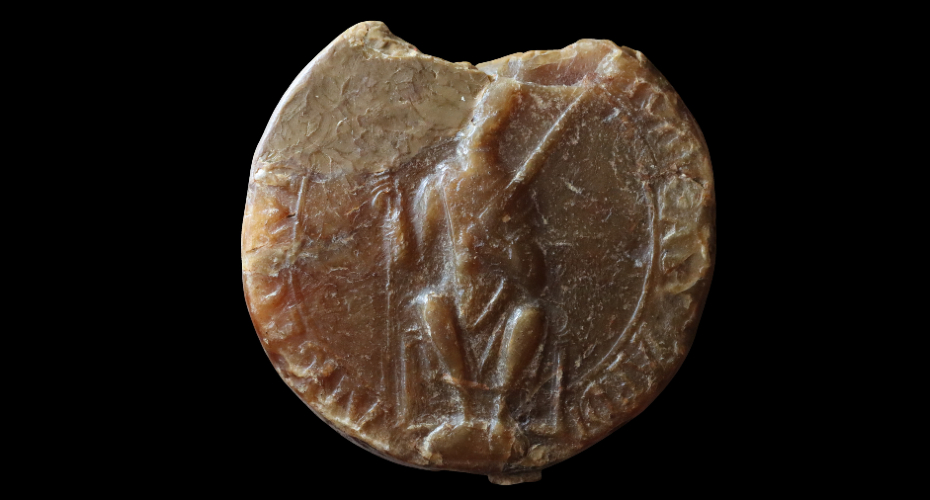
“You might think that it’s self-evident that a sword should be a royal attribute,” said Dr Dorandeu. “But at this point in English history, it’s almost not been used. We do see it, however, in the Byzantine coinage, where it had been introduced no more than five to ten years earlier. So, this suggests strong connections with, and quick responses to, Byzantine iconography, either directly or as it was transmitted through Europe.”
In the paper, the authors consider the seal in relation to the emergence of a new type of document called the writ-charter – used by kings to grant land or rights and simultaneously command local officials to enforce that grant. Records show that seven originals and numerous copies survive from Edward’s reign, compared with no originals and a handful of copies before it.
“The writ-charter, in its classic form as a sealed document, is almost certainly a novelty of Edward’s reign,” said Professor Roach. “And we are seeing a new kind of seal to authenticate this new document. Edward is adopting a continental form of authentication, which sits perfectly alongside the iconography of the seal itself, and his own hegemonic ambitions.”
The authors say that findings strengthen the view that England’s ruling class was already strongly influenced by continental Europe – including Norman France – well before the Conquest of 1066.
Lost and Found: the Saint-Denis Seal Impression of Edward the Confessor (1053 × 1057) and the Development of the Early English Writ-Charter is published in Early Medieval England and its Neighbours.