
Scientists identify the most urgent research questions facing the world’s peatlands
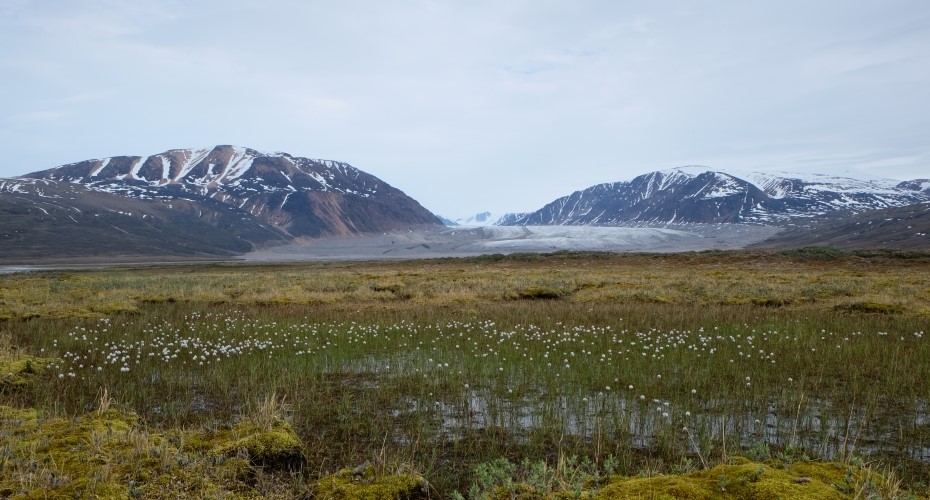
Peatlands on Bylot Island, Canada. Credit Angela Gallego-Sala
Researchers including from the University of Exeter have identified the most urgent unanswered questions about peatlands, providing a global roadmap to guide future science and policy for one of the planet’s most important and threatened ecosystems.
Peatlands only cover about three per cent of the Earth’s land surface but store more carbon than all of its forests. When healthy, they lock away carbon for thousands of years, but drainage, fire, extraction or land-use change can quickly turn them into a large source of greenhouse gas emissions.
Despite their importance, we still lack key knowledge about how peatlands respond to climate change, how to restore them effectively, and how to protect them while supporting the local and Indigenous communities who rely on them.
The questions selected capture priorities across a range of boreal, temperate, and tropical peatlands, including those in Europe and the peat swamp forests of Southeast Asia and the Arctic tundra. They include:
- What is the global extent and distribution of peatlands, including those in areas that are currently poorly mapped?
- What are the tipping points at which some peatlands shift from carbon sinks to carbon sources, what techniques can be used to determine tipping points and what factors make some peatlands more resistant to change than others?
- What are the most effective approaches to integrate traditional ecological knowledge or knowledge from Indigenous peoples into sustainable peatland management and restoration, and can this approach enhance the success of restoration efforts?
- How can remote sensing and other existing and emerging technologies (including AI) be used to improve our understanding of peatland dynamics, support peatland monitoring and management, and address the challenges of peatland research?
- How can global environmental initiatives incentivise peatland management in equitable and just ways that benefit and empower local communities and organisations as agents of change, whilst optimising climate, biodiversity, and ecosystem services?
By surveying and analysing opinion from international peatland experts, the research highlights where knowledge gaps exist and where new information could make the biggest impact in for climate mitigation, biodiversity conservation, and sustainable land management.
“Peatlands are increasingly recognised as critical ecosystems for climate action, but we still don’t have all the answers we need to manage them effectively. By identifying the most urgent research questions, this work helps focus global effort,” said Dr Alice Milner from Royal Holloway University of London and lead author.
Interest in peatlands has grown rapidly in recent years as countries look for nature-based solutions to help meet climate targets, but the authors warn that without clear research priorities, investment risks being fragmented and short-term, potentially undermining long-term outcomes.
“Restoring peatlands is not as simple as just ‘rewetting’,” said Dr Michelle McKeown from University College Cork. “There are important trade-offs, uncertainties, and regional differences that we still don’t fully understand. These priority questions help ensure that peatland management is helping, not harming, climate and biodiversity goals.”
Importantly, the priority questions extend beyond biophysical science. Many focus on governance, land-use decision-making, and the role of Indigenous and local knowledge in peatland management; areas that have historically received less attention in global research agendas.
Professor Angela Gallego-Sala from the University of Exeter said: “Peatlands are not empty landscapes. They are lived-in, worked landscapes with deep cultural significance. This is particularly true in the tropics, where peatlands can be a resource – sometimes the only one – that provides livelihoods, so it is important that as researchers we acknowledge this and provide answers that are useful to these communities too.”
The authors hope the priority list will be used by the peatland research community, funding agencies, research institutions, and policymakers to guide international collaboration, investment and future research.
“Peatlands can either help stabilise the climate or accelerate its change,” said Dr McKeown. “Which path we take depends on the knowledge we build, and how quickly we act on it.”
“Priority research questions in global peatland science” is published in Communications Earth & Environment.