
Measuring light shows Gaza’s economy collapsed by 75%
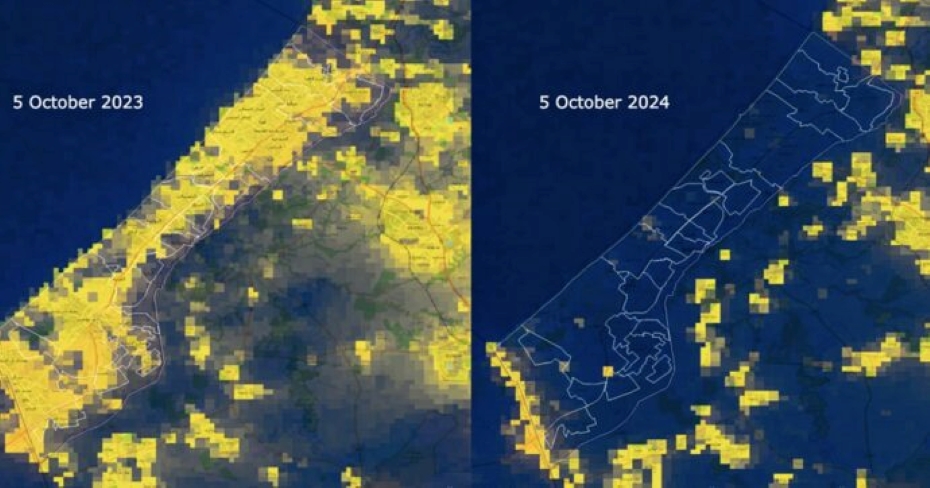
Image credit: Dr Daniele Rinaldo
A new method of calculating the economic impact of war on economies shows that three-quarters of Gaza’s economy was wiped out in the first year of the Israel-Hamas war.
Previous efforts to calculate the economic impact of war in Gaza have relied on official statistics, which can be contested or politically charged, so the researchers turned to high-resolution radar data from NASA’s Sentinel-1 satellite to produce a more “neutral” picture of the damage.
Mapping the area using high resolution satellite images the researchers found that 82 per cent of each square kilometre of Gaza’s land surface had been damaged at least once in the first year of war, and that 67.9% of the built environment had been destroyed.
They then measured economic damage using data on the amount of light visible at night, a proxy for economic activity as it indicates whether there is power, as well as the level of activity in sectors such as manufacturing, agriculture, healthcare, retail and other services.
They recorded a 68.5 per cent reduction in light seen at night from space, with a slight improvement recorded during the ceasefire in November 2023.
They calculated the economic damage by comparing the luminosity data with levels before the war, and linking in data on household income and spending.
They estimated that GDP in Gaza had fallen by 75% overall, with a collapse of 97% in areas most affected by the bombing.
“This is basically a lower bound for the real damages because we don’t measure human losses, human capital losses, schooling losses, all of these sort of things which are very much there. This is just because of the physical damage,” said Dr Daniele Rinaldo from the University of Exeter Business School.
They also estimated a loss to household expenditure – how much individual households spend on food and necessities in general – of around $2.6 billion for the first year of war, a figure that does not include any of the future impacts to spending.
The researchers say their new method of measuring the economic impact of war, a combination of satellite remote-sensoring techniques and advanced data modelling and statistical analysis, could be applied to all wars, humanitarian crises and large-scale disasters.
Dr Rinaldo added: “The problem with using reported data or official statistics in a conflict is that the data is either not available, because a conflict is going on, or that the available data is fought upon from an informational perspective and accused of being politically biased.
“We use satellite-based measurements, as they are physically and statistically based metrics which offer insights into dynamic and cumulative economic impacts of the war that are independent of data collected by either conflict party.”
The destruction of Gaza: Satellite measurements of the economic cost of war is published in PNAS Nexus.