Beyond the rhetoric: global leaders demand accountability at Reparative Futures conference
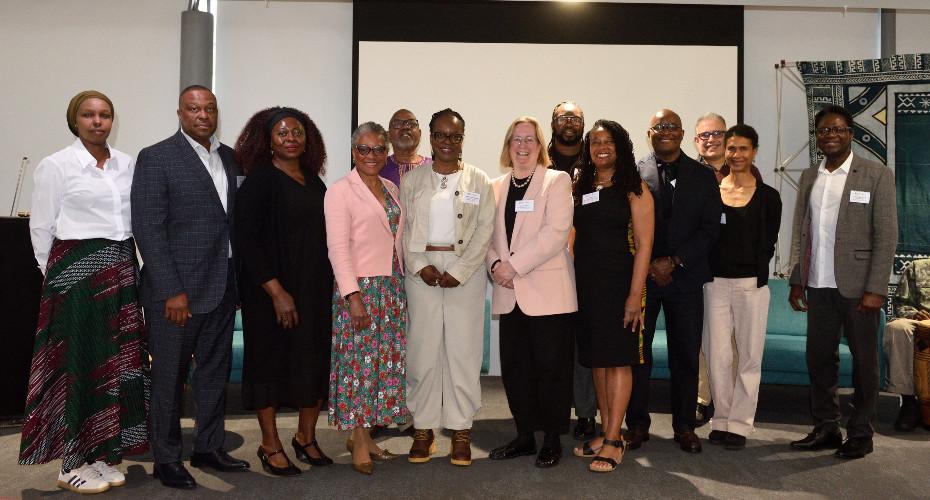
Around 200 scholars, civil society organisers, politicians, activists, artists, students, and community knowledge holders gathered for a landmark international conference which explored how higher education institutions can become accountable partners in repair, justice, and transformation.
The event featured academics from the University of Exeter and was hosted by the University of Bristol’s Reparative Futures programme.
Launched in February 2024 and running through to 2034, the Reparative Futures programme seeks to address systemic injustices rooted in historic enslavement while confronting ongoing anti-Black racism within the University and wider society.
Held alongside the World University Network (WUN) Annual General Meeting, the conference brought together speakers and delegates from across all six continents impacted by the histories of chattel slavery and colonialism.
The event featured contributions from Dr Safi Darden and Dr Melody Kuziwa Jombe from the University of Exeter, who introduced their B-HUGs (Black Heritage University Groups) initiative. They explained how B-HUGs programmes intentionally operate with Black specificity to reclaim access and opportunity and to foster belonging. The programmes work toward providing spaces for representation, affirmation and critical consciousness raising as a means of countering epistemic and affective harm experienced in the education system.
Professor Suchith Anand, Professor of Practice in Science Policy at the University of Exeter, highlighted the urgent need to decolonise data systems and research practices to prevent historical biases from being embedded within modern academic and technological frameworks.
Professor Helen Berry, Deputy Pro-Vice Chancellor, Faculty of Humanities, Arts and Social Sciences, University of Exeter, said: “The Faculty of Humanities, Arts and Social Sciences was very pleased to support participation of our colleagues at this significant event. The pursuit of racial equality is a vital intersectional component of our mission to further social justice not just in academia but in the wider world.’
Professor Rajani Naidoo, University of Exeter Deputy Vice-Chancellor (People and Culture), said: “The Reparative Futures conference highlighted the vital role universities can play in advancing equity, inclusion and social justice. Creating environments where historical and contemporary inequalities can be openly addressed is central to the future of higher education. We are proud of the leadership shown by our colleagues in helping to build partnerships that support meaningful and lasting change.”
Opening the day, Dr Marie-Annick Gournet, Associate Pro Vice-Chancellor for Reparative and Civic Futures at the University of Bristol, emphasised the responsibility of higher education institutions to engage meaningfully with their historical legacies.
She said: “It was crucial to use the opportunity of the WUN AGM to highlight the important role that all higher education institutions have to play in the repair of that traumatic history. They were complicit – directly or indirectly, in one way or another, before or after – in reinforcing or maintaining that legacy.”
The conference featured ancestral grounding through a drum call and prayer led by artist Kofi Ayiih, and Dr Erica McInnis spoke about the enduring psychological trauma of enslavement through an A to Z framework of emotional and intergenerational effects.
The opening panel traced the grassroots activism that pushed institutions toward reparative action.
Momentum built through campaigns following the contested 2007 abolition commemorations, intensified during the 2015 Rhodes Must Fall movement, and accelerated in 2020 amid Black Lives Matter protests, the toppling of the Edward Colston statue, and renewed student demands to decolonise the curriculum and rename university buildings.
A central focus of the conference was the question of what meaningful institutional repair should actually look like, particularly in light of the University of Bristol’s landmark 2020 report examining its historical links to slavery.
Professor Olivette Otele, author of the report and now Professor of Legacies and Memory of Slavery at SOAS University of London, reflected on the progress made since the report’s publication.
The next Reparative Futures Programme report be co-written collaboratively with community partners and international leaders.
For more information on the Reparative Futures Programme, or to access speaker profiles and panel notes from the event (shared under ethical agreement), please contact reparative-futures@bristol.ac.uk.