
New ‘genetic tools’ could protect UK’s pollinators
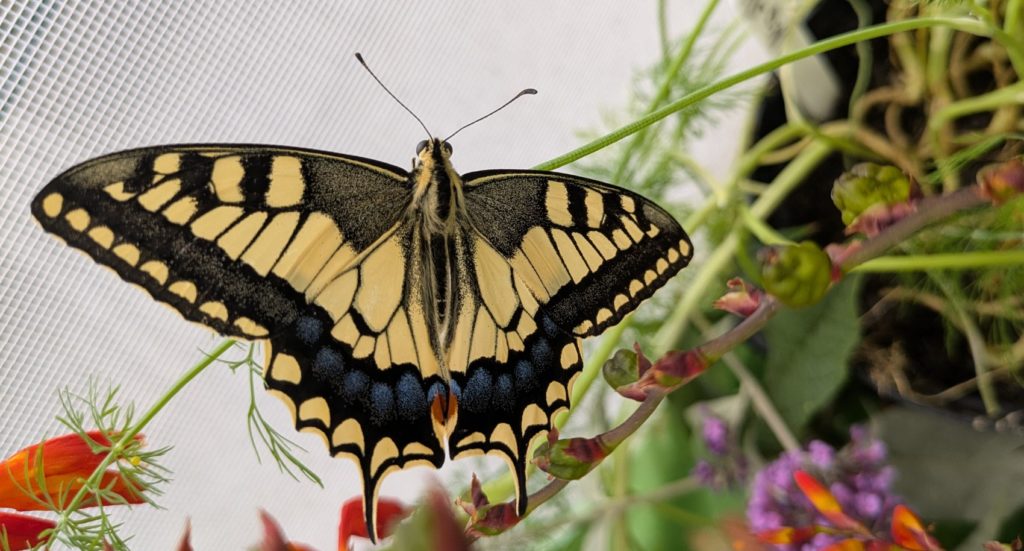
A swallowtail butterfly. Credit Bartek Troczka
Scientists aim to develop “genetic tools” that could protect the UK’s pollinators from population collapse.
Pollinators face mounting pressure from insecticides, habitat loss and new disease risks driven by climate change.
The new project work will: identify how bumblebees fight infections, and the genes needed to cope with future threats; engineer insecticide resistance in swallowtail butterflies; and develop a gene-editing method that works by injecting adult insects.
Led by Dr Mark Hanson and Dr Bartek Troczka (University of Exeter) and Professor Luke Alphey (University of York), the project has been awarded £5.65 million by the UK government’s Advanced Research + Invention Agency (ARIA).
“With ARIA’s support, we have assembled an amazing team to build some genetic resilience into UK pollinators,” said Dr Hanson, from the Centre for Ecology and Conservation at Exeter’s Penryn Campus in Cornwall.
“With increasing awareness of the need to improve UK food security, this project comes at the right time to anticipate and prepare for future climate change.
“It’s a chance for us to get ahead of the curve for once, rather than get caught flat-footed.”
The project brings together three research groups to tackle key challenges facing the UK’s pollinators, and its work will cover three linked strands:
- One will catalogue the antimicrobial peptides bumblebees use to fight infection, and identify the genetic variants needed to cope with future UK pathogens.
- A second will engineer insecticide resistance into a GB Red Listed British butterfly, the swallowtail, as a proof of concept that vulnerable insects can be given specific genetic assistance.
- A third will develop a gene-editing method that works by injecting adult insects rather than requiring lab-reared young, making it adaptable to a much wider range of species.
Dr Troczka said: “I’m absolutely delighted that ARIA has chosen to back our project. It’s the culmination of years of work on insecticide resistance, and now we get to put that knowledge to use protecting some of the UK’s most iconic butterflies.”
The funding is part of ARIA’s Accelerated Adaptation programme.
Backed by £54 million, the Accelerated Adaptation programme is looking to demonstrate that we can accelerate the adaptation of wild species and build the scalable tools, models, and governance foundations to unlock a genuine new option for conservation, complementing established stewardship and the essential work of reducing the pressures driving nature’s decline.