‘Real opportunity’ to boost low-carbon European holidays
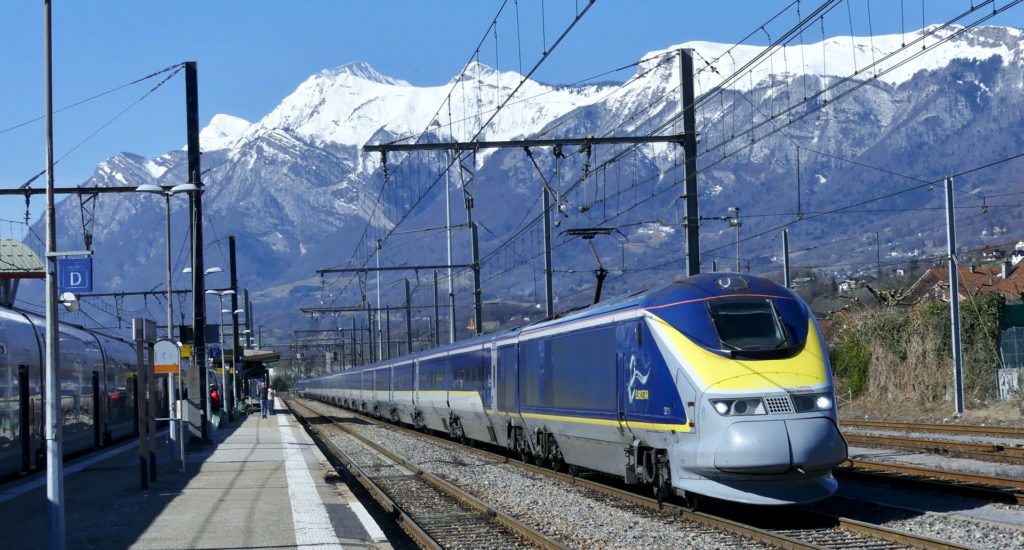
Eurostar high speed train arriving at Albertville in France. Credit Florian Pépellin. Wikimedia Commons (CC BY-SA 4.0)
UK holidaymakers and the tourism industry have a “real opportunity” to shift to low-carbon European holidays, researchers say.
Air travel is deeply embedded in the way many people take holidays. However, it has significant environmental impacts, and concern about climate change is increasing among the public.
Rather than focusing only on customer choice, University of Exeter experts say it’s key to understand the mix of marketing, booking processes, infrastructures and support that influence decisions.
After running focus groups with customers from travel brands Inghams and Inntravel, researchers have created a new “toolkit” that sets out how eco-friendly travel to Europe – mostly by train – could become cheaper, easier and more desirable.
“People don’t want to damage the environment when they travel, but at present they face significant barriers if they choose some of the low-carbon options,” said Dr Ewan Woodley, from the University of Exeter.
“For example, booking a flight from the UK to European holiday destinations is easier and often cheaper than going by train.
“But there’s a real opportunity to re-imagine holiday travel for the better – and our aim here is to provide a guidebook on how to get there.”
The Exeter team ran workshops with 50 of Inghams and Inntravel customers about their general experiences of train travel for holidays.
Some raised the difficulties of train and ferry travel, comparing this with fast, “seamless” airline booking.
The researchers highlight three areas to focus on:
- The social desirability of how we travel for holidays and the value people gain, such as feelings of belonging, status, acceptance and affirmation.
- The infrastructures and technologies that support how we travel, from booking systems to terminal buildings.
- The skills or know-how required to travel for holidays, from the process of booking to successfully using a particular transport mode.
Dr Woodley’s key recommendations are to make “no-fly” holidays visible – promoting the green travel experience – and to follow the lead of airlines in making it quick and easy to book travel.
The toolkit’s other recommendations include:
- Government should invest in UK rail reliability and quality, and better connectivity to Europe.
- Fair tax. Flight prices do not reflect the environmental cost, and give air travel a significant price advantage over no-fly travel.
- Customers can “lead and lobby” – setting positive examples of green travel and lobbying those in power to make change.
- The travel industry can reduce fears (e.g. risk of journey breakdown) and provide clear information including videos on how to navigate journeys.
Krissy Roe, Head of Sustainability at Inghams, said: “Lower-carbon travel should be an easy, attractive choice, not the harder one. Over the past three years, Inghams has grown its rail offering so that more than 30% of our resorts can now be reached by train. We know the appetite for lower-carbon travel exists. As this research shows, better connectivity, fairer pricing and greater reliability will be essential to making lower-carbon travel accessible to everyone.”
Lucy Saggers, Inntravel Sustainability Executive, added: “At Inntravel, we want to build on the number of customers who already choose rail for at least one leg of their journey to our walking holidays. Travel Towards Net Zero provides the evidence to support the shift in travel choices that both we and our customers want to see. It also offers valuable, practical guidance on the steps individuals, governments and tour operators can take to make lower-carbon travel more accessible and easier to choose.”
Professor Stewart Barr said: “Together, government, the tourism industry and customers can change how we think about travel. Instead of viewing travel as how to get from A to B as quickly as possible, we can think about the many benefits of ‘slow travel’. Taking a train through a country gives a greater sense of connection to your journey, making that part of the experience – rather than something to be endured before a holiday can begin.”
The research, funded by the Economic and Social Research Council, was carried out by Professor Stewart Barr, Dr Alex Gough, Professor Gareth Shaw and Dr Ewan Woodley.
The new toolkit is called: “Travel towards net zero: a toolkit for low-carbon tourism travel.”
It will be launched at an online event for the tourism and travel industry today (Wednesday) at 12:30 BST. For more information and to register, visit: https://www.eventbrite.co.uk/e/travel-towards-net-zero-a-toolkit-for-low-carbon-tourism-travel-tickets-1993596789664?aff=oddtdtcreator