
Opinion – The Unfinished Experiment: 250 Years of Watching America
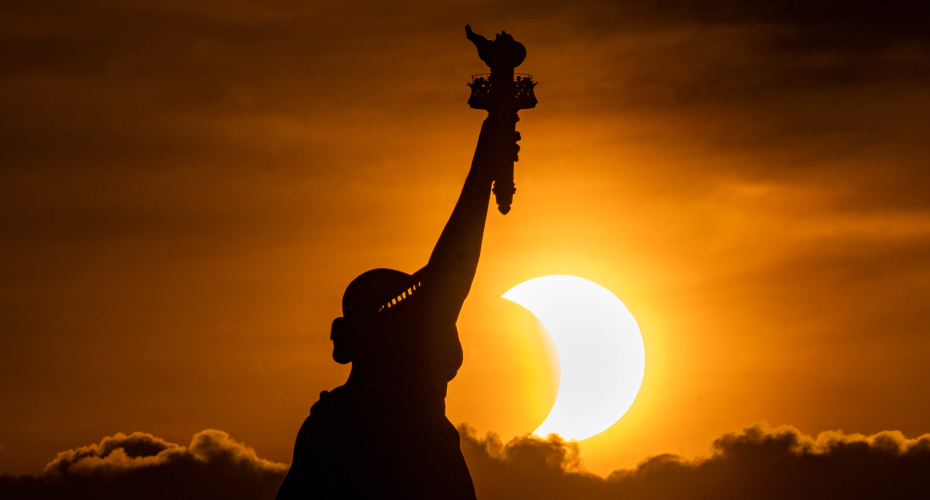
The Statue of Liberty during a solar eclipse. Photo by Anthony Quintano from Mount Laurel, United States, via Wikimedia Commons
by Professor Kristofer Allerfeldt
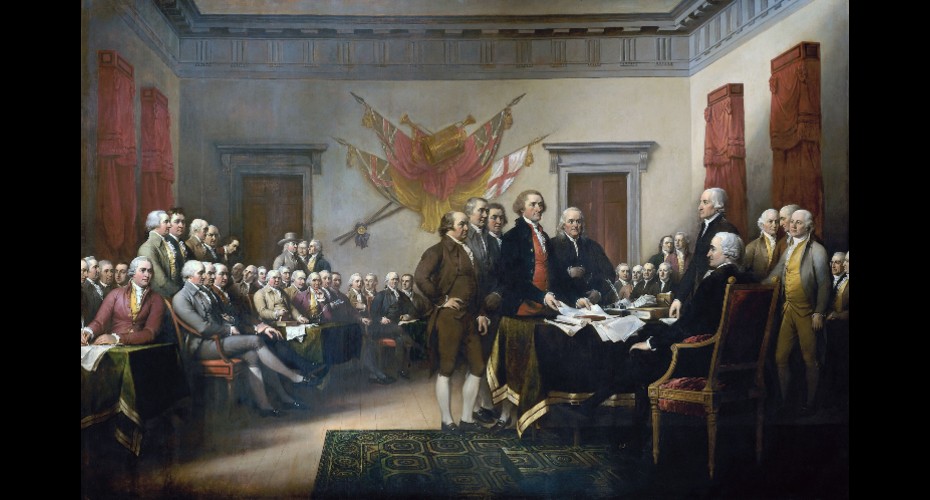
No political project in modern history has been watched more closely or perpetually condemned for not reaching its stated ideals than the United States. Born on July 4, 1776, this year it will be 250 years old. For over a quarter of a thousand years, the American Experiment has been seen as not just an ambitious project in democracy but also, for much of its history, an inspiration – and often refuge – for the most downtrodden of other nations. This means the anniversary of its founding is not merely an American occasion. It has global significance.
To most of the watching world, America’s 1776 Declaration of Independence was either the culmination of Enlightenment thinking or a suicide note written by dreamy idealists. European monarchies regarded it with contempt. A republic governed by the consent of the governed? Theoretically interesting. Practically doomed.
In Britain, some dismissed Jefferson’s Declaration as a statement of the colonists’ grievances. Others saw it as a perpetuation of the spirit of the Glorious Revolution, asserting the rights of Englishmen against tyranny. Yet another group, including the King, saw it as treason and prepared to put down the rebellion. Over the Channel, in France, it was regarded as one in the eye for the traditional enemy. Most observers expected the republic to collapse within a decade, and the contradictions that spurred that pessimism were visible from day one.
As if to mark the fact that the republic had survived 50 years, on July 4th, 1826, its author, Thomas Jefferson, died: his work complete. On the other side of the Atlantic, throughout Europe, the American model haunted the continent’s reactionary restorations after a quarter of a century of revolution and war. Europe’s leading diplomat, Klemens von Metternich and others viewed American-style republicanism as a dangerous infection, a revolutionary bacillus which needed to be kept at bay.
But while Europe sought to quarantine the US, Latin America was paying closer attention. Simón Bolívar had liberated much of South America, invoking the American example, yet he also remained remarkably ambivalent. He admired American institutions but doubted they could be transplanted to societies shaped by Spanish colonialism. His misgivings would prove prescient.
And there were fractures in the US itself. The most serious was around slavery. British abolitionists looked at America in despair. The US abolished the Atlantic slave trade in 1808, and there was growing pressure to abolish slavery itself. Yet without ever mentioning the word, the 1787 US Constitution had enshrined slavery, and America’s slaveholders and slave traders worked that ambivalence. The result was that the slave republic absorbed more and more of the seemingly endless territory of the American West as the Cotton Kingdom was expanded. At fifty, the American Experiment looked vigorous and prosperous. It also looked, to much of the world, morally compromised at its very foundations.
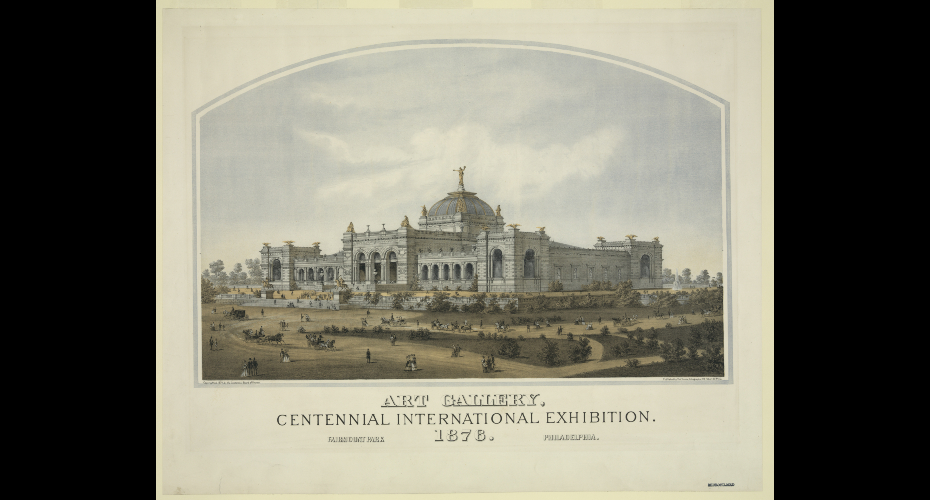
The 1876 Philadelphia Exposition celebrated the first hundred years of the Republic with millions admiring the wonders of American modernity. On display was the vast and sophisticated 1400 horsepower Corliss steam engine, Alexander Graham Bell’s telephone and the Remington QWERTY typewriter. To the world, America looked like the future arriving ahead of schedule.
But the promise of racial equality that the Civil War had given also had its last gasp that year. The last Federal troops protecting the freed slaves were withdrawing from the South. The radical promise of Black citizenship was being dismantled through violence and legal chicanery. The centennial was celebrated while, across the former Confederacy, freedmen were being driven from polling places.
But for working-class Europeans, America remained the last resort of desperate hope. The great migrations had begun in the 1840s with the exodus of millions of Irish fleeing famine. It would continue with liberals escaping the crushed revolutions of 1848, Bismarck’s Kultur Kampf and countless Jewish pogroms. Over the coming years, millions more Europeans, Chinese and other hopeful emigrants would pour in, drawn by economic possibility, even as political equality receded. To both foreign and domestic observers, it appeared that America faced new dilemmas. Should the republic concentrate on nurturing the vast possibilities of economic opportunity, even at the expense of the ideal of political equality, especially when many of those demanding those rights had not even been born in the USA?
Arguably, by 1926, America was no longer an experiment, it was a fact of nature. For some years it had been the largest economy on earth. It had first mobilised its massive industrial and agricultural resources and then its manpower to turn the fate of Europe in the Great War. In the wake of that display of power, it was reshaping global culture from glittering Hollywood to smoggy Detroit.
To some foreign observers, America was an irresistible mix of consumerism, skyscrapers, movie stars, jazz and neon-lit cities. To others, it was the burning crosses of millions of Ku Klux Klan and the dog-eat-dog urban jungle of prohibition Chicago.
Immigration restrictions had slammed the door on vast numbers of Europeans and all but barred African and Asian immigration. The poetry of the Statue of Liberty now seemed a mockery. What was more, President Woodrow Wilson’s promise to use the might of America to defend a world safe for democracy had morphed into a relentless mission to recoup America’s outstanding war debts from an already impoverished Europe.
At 150 years old, the USA may have inspired a mix of awe, resentment and imitation, but it was still a nation that seemed to have unlimited potential. Fifty years later, it looked like a nation that might not survive to see 250. President Nixon had resigned in disgrace. Inflation was destroying the promise of an ever-expanding wealth, and its youth wanted revolution. Nor were all its problems domestic. The Soviet Union had achieved nuclear parity. OPEC had demonstrated that oil-rich nations could bring American highways to a standstill. Nations across Africa and Asia, many covertly destabilised by American Cold War policy, regarded the bicentennial with undisguised scepticism, leaning instead towards the Soviet model of government.
Yet there was also a spark of its old optimism. The bicentennial coincided with a frank national reckoning. The country was facing its many problems head-on. A free press revealed the cynical debacle of Vietnam with the Pentagon Papers and highlighted the accountability of the Presidency by exposing Watergate. America appeared capable of looking at itself without flinching. That self-correcting instinct, exposing even its own worst failures and occasionally repairing them, was perhaps the experiment’s most underrated feature. The world in 1976 saw a superpower in genuine crisis. Whether that crisis would produce renewal or decline remained, as ever, unresolved.
Two hundred and fifty years. The anniversary arrives in a world where the old certainties seem to have disappeared. China has matched American economic output. Climate change threatens to make swathes of the globe uninhabitable to both humans and other species and threaten hitherto unprecedented migrations. Artificial intelligence is demonstrating the power to upend economic stability and security and revolutionise warfare. Deepfakes and large language models are now capable of obscuring and weaponising truth itself. Liberal democracy, which so recently looked triumphant, is now embattled globally, perhaps most glaringly in the United States itself with the Capitol Riot of January 6th 2020.
Rather than leading the “free world”, America has a President who appears to be intent on dismantling the post-World War Two certainties and safeguards, insulting its long-term allies and constantly unleashing the rhetoric of war on his foes. Behind this are the seemingly intractable problems of the opioid crisis, constant reports of mass shootings, widening wealth gaps, escalating healthcare costs and infrastructure decay.
So, in 2026, a quarter of a millennium after its founding, is the American experiment doomed? It has seemed to be since the start. Anniversaries of American independence have always shown how fragile American institutions, wealth and democracy have been. Yet even now, as the threats seem even more existential than ever, a great many observers feel that American ideals will still triumph. They point to the national resilience, energy and ingenuity generating the ability to expose, face and rectify huge problems in the past. Call me naive, but whatever happens in the next 50 years, I believe there will still be a United States. But I am also sure that it will be almost as unrecognisable to us as it would be to the Founding Fathers. It seems the only constant in American history is change.
Professor Allerfeldt is an Associate Professor of History in the Department of Humanities and Social Sciences at the University of Exeter, Cornwall. He is an expert in modern American history, with a particular research interest in ethnicity, immigration, bigotry and criminality.