Poetic response to Ronald Duncan installed on South West Coast Path
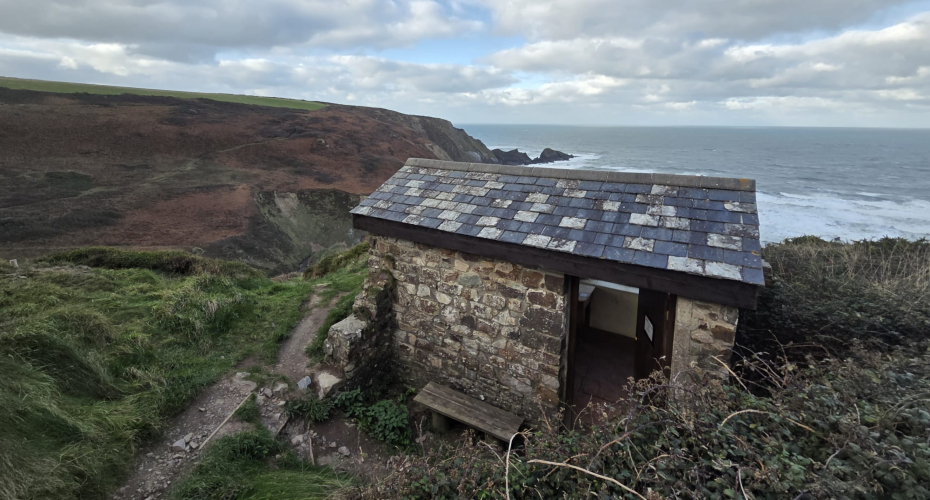
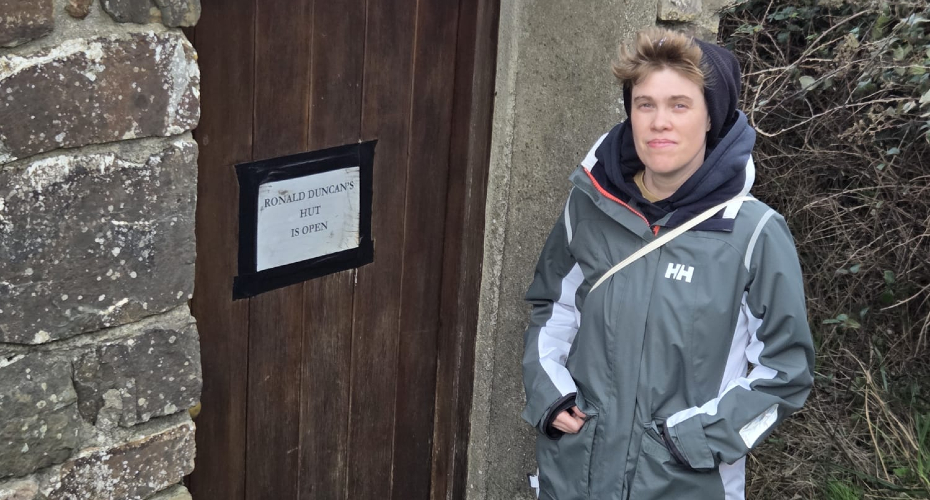
The Ronald Duncan Writing Hut
An innovative piece of creative writing and sound art, inspired by the artistic legacy of West Country author Ronald Duncan, has been installed on the South West Coast Path.
Visitors to the Ronald Duncan Writing Hut, located near Welcombe, will be able to access the piece, titled solmōnaþ [i was born in the mud month], via a QR code.
The work has been created by Sam Godfrey, one of three recipients of the first Ronald Duncan Stipends for Southwest Writing, in partnership with the University of Exeter’s Special Collections.
The Stipends were launched last year with funding from the Ronald Duncan Literary Foundation, with a view to continuing the author’s legacy of experimental and multi-disciplinary writing.
To celebrate the occasion, a special reading took place in the hut, with an audience of project members joined by some local walkers.
“It is wonderful to see the first stipend project realised,” says Caroline Walter, Head of Heritage Collections at the University. “Sam’s work lies at the heart of what this stipend was established for: providing opportunities for South West writers to engage with the University’s unique collections and create exciting new works that bring them to wider audiences. I hope everyone who encounters the work along the South West Coast Path enjoys taking a moment to reflect, listen and engage with it.”
After winning the Stipend, alongside fellow creatives Sama Hussein and Alex MJ Smith, Sam spent some considerable time reading Duncan’s autobiographies in the archive of literary and personal papers. They said they was particularly interested in “trying to piece together his relationship with Welcombe”, alongside Duncan’s attempts at farming and how he viewed the land more generally.
During their research, Sam was drawn to Duncan’s 1964 play O-B-A-F-G: a play in one act for stereophonic sound, which imagines the birth of matter and the universe. They were also inspired by Duncan’s 1969 poetry and sound collaboration with the BBC Radiophonic Workshop called The Seasons, which imagines the cyclical nature of the months and seasons as a series of anthropomorphic encounters.
“The work of people like Daphne Oram and Delia Derbyshire at the BBC Radiophonic Workshop during the 1960s has always been a huge inspiration to me,” Sam said. “And it was amazing to go and listen to The Seasons in the Special Collections and sit with its distorted sounds that were concocted with Duncan’s strange poetry over the top. It’s quite haunting and even stranger to think that this was intended for drama and dance workshops with school children! The work impacted how I created the sounds and the creative writing, and I think I imagined it as a sort of response to Duncan.”
Sam’s poem takes its name from the Anglo-Saxon term for ‘February’ and is divided into three parts, focusing on a specific snag tree (a term for a dead or dying tree), the ferns they encountered, and the land around Welcombe.
The soundscape, meanwhile, was composed from Sam’s field recordings when they visited Welcombe in October last year, mixed with archival sounds from the BBC and distorted through specialist software.
Sam said: “The work is intended to challenge the way that Duncan imagined the linearity of matter, nature and the landscape around him in Welcombe, and provide an alternative interaction that uses mythology, the queerness of plants and the way we are entangled in these non-human relationships. If nothing else, I hope the soundscape provides an interesting intervention into people’s hikes along the South West Coastal Path!”
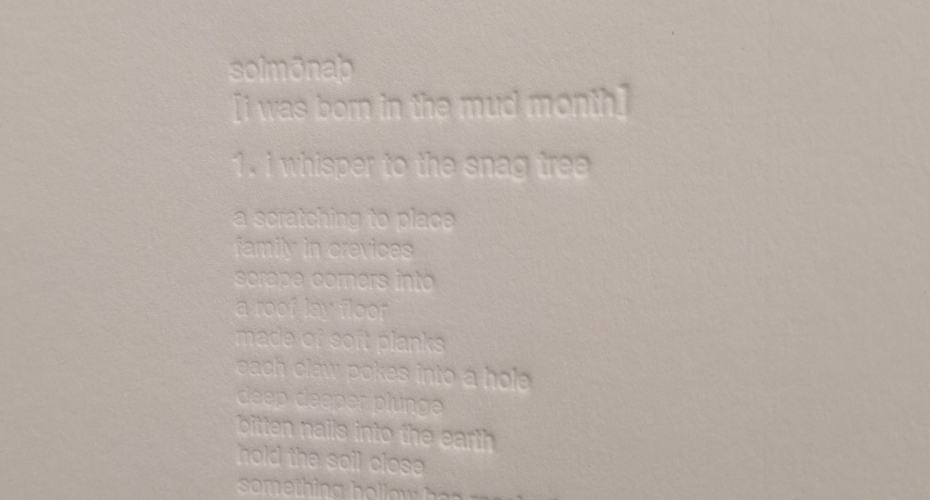
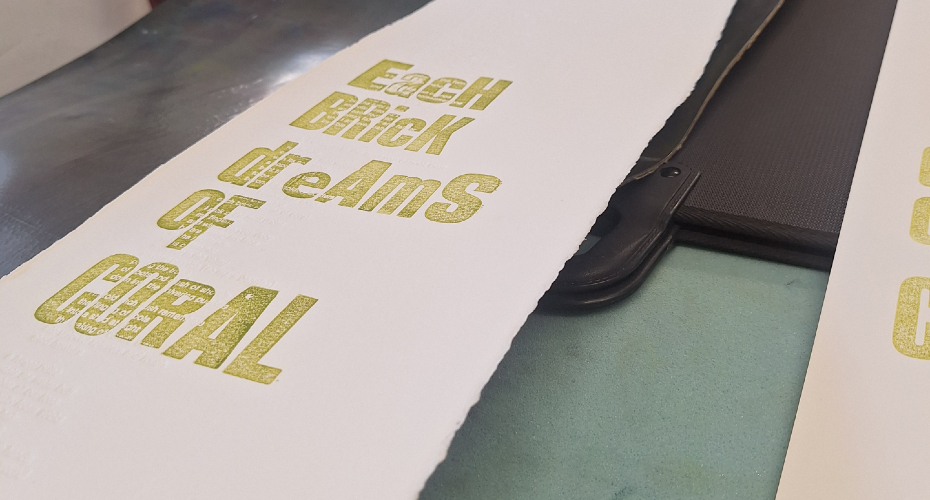
As part of this project, Sam also worked with Double Elephant Print Workshop in Exeter to letterpress copies of the poem using a blind embossing technique.
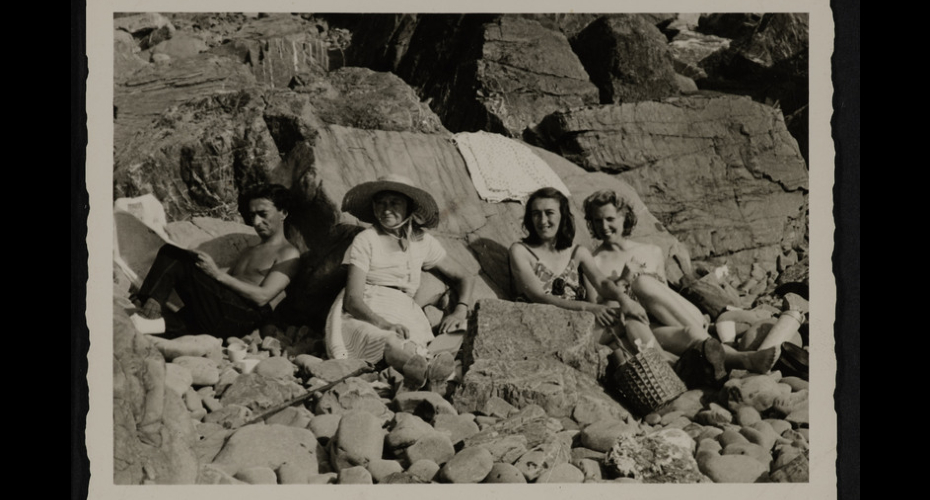
Ronald Duncan (1914-1982) was an author, journalist, playwright, poet, and scriptwriter, perhaps best known as the librettist for Benjamin Britten’s The Rape of Lucretia (1946) and for his poem The Horse, which is read annually at the Horse of the Year show. His career encompassed experiments with several writing forms, including his epic poem Man (The Complete Cantos, 1980), and the aforementioned O-B-A-F-G.
Duncan left the legacy of a fascinating archive of literary and personal papers, the Ronald Duncan Collection, which was donated to Special Collections in 2016.
The stipends were launched last year and offer South West creatives the chance to interact not just with Duncan’s archive, but all the special collections held on the Streatham and Penryn campuses. The stipend covers a full 12 months, and at the end of that period, the winners deliver a unique piece of work or public outreach event that could include a short story, poem or piece of prose; dramatic work; or a graphic novel or zine.
For more information, visit the University’s website.
The installation of the poem has been welcomed by the South West Coast Path Association. “We are looking forward to listening to Sam’s poetry,” said Aletha Mays, Head of Communications. “The Ronald Duncan hut is a popular site for walkers to pause and reflect on their hiking journey. The addition of Sam’s work will only enhance the experience of walking this spectacular stretch of coastline. We are excited to hear people’s response to the poetry and soundscape and wish Sam and the team at the University of Exeter every success with the project.”