
UK faces ‘highly concerning’ wildfire risk this weekend – Exeter experts comment on heatwave
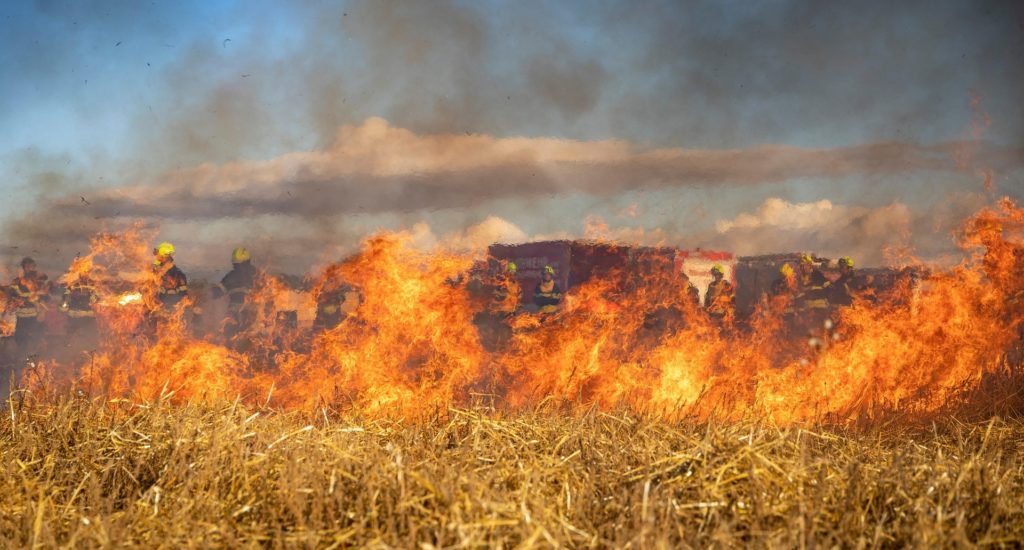
A wildfire on grassland, with firefighters visible in the background through the flames and smoke
The UK may be facing its worst-ever risk of wildfires this weekend, a leading expert says.
The warning comes as University of Exeter researchers comment on multiple aspects of the ongoing heatwave, which is affecting the UK and much of Europe.
Here’s what the researchers say:
Professor Claire Belcher, Exeter’s Chair of Wildland Fire and Director of the wildFIRE Lab, said: “UK wildfire risk is highly concerning right now. Large parts of the country are on red wildfire alert for the second time ever – the last being July 2022 when 19 homes were destroyed by wildfire in Wennington.
“Our fire behaviour prediction system, FireInSite, shows the highest risk of ignition we have seen on the system since it was built. This Friday, many highly environmentally valuable areas across the UK – such as Dartmoor, and Devon and Dorset’s heathlands – show a 100% chance of a spark being able to start a fire in grass.
“Across the UK, current conditions meet the 30:30:30 rule for wildfires – 30°C, 30% humidity, and 30km/hr wind speeds. This is a line imposed globally that makes wildfires highly likely. This might actually be the first time the UK has crossed the 30:30:30 boundary.
“All this means that heatwave conditions today and over the weekend pose considerable fire risk to crops and our semi-natural landscapes – particularly heathlands, moorlands and grasslands.
“Communities should be urged to be particularly careful with ignition sources. There have been several wildfires already over the last week, including around Exeter. This closed a large section of the M5 and A38 westbound from Exeter for hours, impacting travel, infrastructure, and the local economy.”
Dr Martina Egedusevic, Nature Impact Fellow at Green Futures Solutions, said: “Wildfire and heatwave risk should not be seen only as an environmental problem. It is also an economic and community resilience issue.
“When landscapes become extremely dry, the natural assets we rely on for farming, biodiversity, carbon storage, recreation and wellbeing can quickly become sources of risk to people, infrastructure and businesses.
“The costs are not limited to damaged land or emergency response. They can show up through road closures, disrupted supply chains, lost working hours, pressure on emergency and health services, reduced agricultural productivity and the long-term cost of restoring damaged ecosystems.
“From a natural capital perspective, we need to treat nature as critical infrastructure. Investing in resilient landscapes, improved land management, water retention, soil health, shade and nature-based solutions is a practical way to reduce future climate risks and protect communities before costs escalate.”
Infrastructure under pressure
Professor Philipp Thies said: “The heatwave and continued high temperatures have tangible effects on engineering infrastructure and service provision. For example, photovoltaic (solar) panels of course need sunlight, but if general temperatures and conditions are too hot, the panels lose efficiency for every degree over 25°C.
“Large thermal power plants, such as nuclear power plants, also need cooling to maintain the power generation cycle. Several nuclear power plants in France have been idled to comply with regulations limiting the return water temperatures to between 25-28°C in order to protect the river ecosystem.
“Similarly, overhead train and grid power lines are engineered for a defined temperature corridor. If cables get too hot, they droop – expanding due to the elevated material temperature and then have increased risk of coming into contact with other structures or equipment, effectively short-circuiting.
“Railway tracks in the UK have been specified for milder weather, and prolonged heatwaves increase the risk of buckling, so trains run either a lot slower or not at all in a heatwave.
“Depending on the frequency of these events, and the economic losses they incur, fundamental adaptation measures to infrastructure and electricity provision might well become necessary in the not-so-far future.”
Dr Aritra Ghosh highlights that today’s third-generation PV systems respond better to heat and therefore keep their efficiency much better during hotter temperatures.
Dr Ghosh added: “Furthermore, using floating solar panels means we could take advantage of more stable temperatures offshore and natural cooling from the marine environment.
“The good news for the UK is that despite these heatwaves, the weather in general means that solar panels in the UK commonly operate more efficiently than most other countries.”
Dr Daniel Williams said: “The sustained hot conditions and multiple heatwaves over summer 2026 are unprecedented, with multiple temperature records being broken, but unfortunately they are a signal of a warming world caused by human activity.
“Infrastructure in the UK is severely exposed to the impact of extreme heat, with passengers travelling on the railways often bearing the brunt. From delays due to equipment failures and buckling tracks, and overwhelmed air-conditioning systems providing an unpleasant (and possibly dangerous) on-board experience, this is a problem that will become worse in future without financial investment.”
Health effects
Professor Theo Economou said: “Extreme heat kills – at least indirectly. Heatwaves compound this mortality burden, hitting vulnerable groups hardest: those with pre-existing chronic conditions, the elderly, children and the socio-economically deprived.
“As climate warming likely drives heatwaves to become more frequent, intense and prolonged, the (ageing) UK population faces mounting risk from infrastructure never built to withstand such conditions.
“Temperature records have been broken multiple times this summer and this has likely resulted in unprecedented negative health outcomes.”
Dr Sam Hu, Impact Fellow at Green Futures Solutions, said: “Heatwaves disrupt the delivery essential services, like healthcare. In sectors such as the NHS, extreme heat can reduce workforce capacity through heat stress, fatigue, dehydration and caring responsibilities, while also increasing demand from heat-related illness, particularly among older people and vulnerable communities. This creates a double pressure: more people needing support at the same time as staff capacity and productivity are constrained.
“Heatwaves can also disrupt product and service supply chains. Medicines, food, clinical products and other temperature-sensitive goods may require additional cooling, altered delivery schedules or emergency handling, while transport delays and infrastructure stress can make delivery less reliable.
“These impacts may show up on balance sheets not only as direct costs, such as overtime, cooling, spoiled products and logistics disruption, but also as lost productivity, cancelled appointments, delayed services and reduced resilience across local systems. In that sense, heatwaves are not just environmental events; they are operational and financial risks for public services and businesses.”
Dr Sariqa Wagley said: “Climate change has increased sea surface temperatures around the coastal marine and estuarine waters of England, making them more favourable for different bacteria to emerge.
“This includes Vibrio bacteria, which can cause gastroenteritis and get inside open cuts to cause wound infections. If you have cuts or open wounds, the advice is not go into the waters until they are healed.
“People who have underlying health conditions, are immunocompromised or are more susceptible to Vibrio infections should avoid eating raw or undercooked shellfish or bathing in the waters.”
Keeping cool
Professor Gesche Huebner, Director of Exeter’s European Centre for Environment and Human Health, based in Cornwall, said: “During hot periods, it’s crucially important to stop the heat from entering a building. This means closing windows when the outside temperature exceeds the indoor temperature, and to use external shading wherever possible, for example by covering windows and glass doors from the outside.
“Many countries have external shutters, awnings, and roof overhangs to create this shading, which create a passive cooling effect – but hardly any homes in the UK are equipped with these features. Instead, we can make do through measures like hanging a bedsheet from the top of a window or using foil like we do for car windscreens.
“However, these are only temporary solutions. We now have building regulation in England setting standards to reduce overheating in new residential buildings, but most of our buildings are older, and we’ll be living in them for many decades. We need to prepare them for the changing climate by retrofitting them with passive cooling solutions.
“In the longer term, we need to look beyond individual dwellings and create cities and towns that are heat-resilient, for example through ensuring we’re optimising green spaces to cool our cities. Introducing elements like white roofs and water features can help.
“Air conditioning (AC) can provide instant cooling, but it also creates challenges such as increasing the warming effect of cities, because AC units emit warm air to the outside – plus, not everyone can afford to buy or run them. And of course, it would be a huge strain for the electricity transmission network if everyone suddenly had AC and used it at the same time.”
Polar heatwaves and ocean impacts
Dr Helen Millman said: “Antarctica is experiencing heatwaves in the middle of winter. At Rothera research station, where we’d expect temperatures around -20°C and snow, we’ve seen temperatures above freezing and rain.
“This isn’t an isolated event: the most extreme heatwave ever recorded anywhere on Earth happened in Antarctica, a 39°C temperature anomaly in March 2022. These events can accelerate glacier melt and weaken the ice shelves that hold back the Antarctic Ice Sheet.
“Heatwaves are not yet fully represented in ice sheet models, meaning future sea-level rise could be towards the upper end of current projections, especially if emissions targets are missed.
“This is worrying because planning is often based around an assumption that 1m of sea level rise by 2100 is the worst-case scenario, but it isn’t. Plausible high-end scenarios exceed 2m by 2100, partly due to extreme events like these heatwaves.”
Professor Brendan Godley, who leads the Exeter Marine research group, said: “Marine heatwaves, which we will be experiencing more often, will disrupt our marine ecosystems, impacting our marine wildlife. Consequently, we need to increase and enhance our Marine Protected Areas in the UK.
“Protected areas are among our most powerful tools for building resilience in the ocean. By reducing local pressures, they give marine ecosystems the capacity to withstand, recover from, and adapt to the impacts of shocks such as marine heatwaves.”
‘Fingerprints’ of climate change
Dr Jesse Abrams, Senior Impact Fellow at Green Futures Solutions, said: “We are in the middle of the UK’s third heatwave of 2026, following a record-breaking May and June. This clustering of extremes within a single season is part of the climate signal.
“Average summer temperatures creeping up matters less than the pattern of climate extremes becoming more extreme and the increasing frequency of these extreme events, which compound to impact infrastructure, ecosystems and financial models built for a cooler, more stable climate.
“This increasing intensity and frequency of heatwaves is one of the clearest fingerprints of climate change. While the immediate costs of a heatwave are visible in reduced labour productivity, transport disruption and pressure on health services, the larger economic impacts often emerge later and in places people do not expect.
“Heat damages roads, rail infrastructure and buildings, reduces the efficiency of power generation and data centres, disrupts supply chains, and can lead to cascading delays across sectors.
“These costs accumulate through higher maintenance costs, insurance claims, business interruption and lower productivity. As extreme heat becomes more frequent, these previously exceptional costs risk becoming part of the UK’s normal operating environment.”