
Flagship event shows DICE Network+ leads the way in driving a digitally enabled circular economy
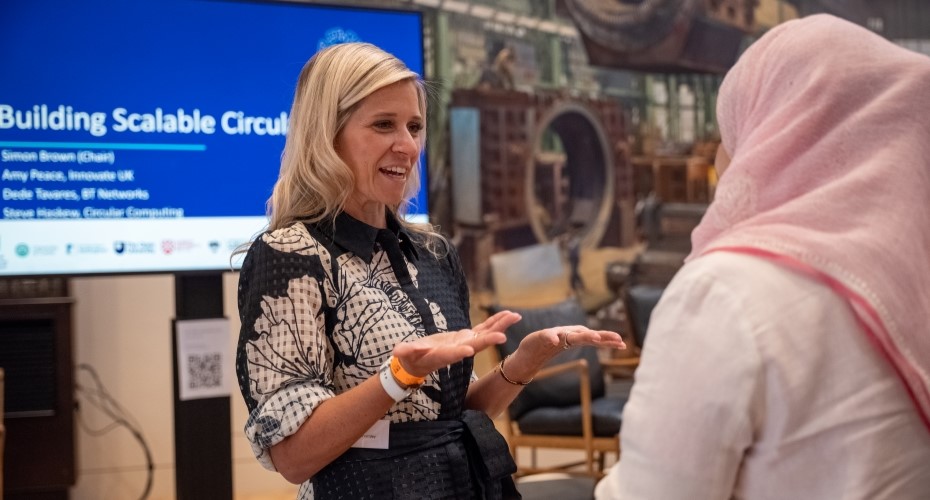
Professor Fiona Charnley
How to make new digital technologies sustainable and how to use those technologies to accelerate the transition to a circular economy are “two sides of the same coin”, Google’s sustainability lead told audiences at the DICE Network+ Transformation Pathways event last week.
Adam Elman, who is Google’s Head of Sustainability EMEA, was among more than 75 industry, policy and research partners who gathered for a day of knowledge sharing and networking held at The Science Museum, London, combining keynote presentations with panel discussions and interactive sessions.
The event marks the midway point of the three-year Digital Innovation and Circular Economy (DICE) Network+ programme, a collaboration between nine UK universities, led by the University of Exeter and funded by the EPSRC, that aims to leverage the power of digital innovation to drive a circular economy across sectors and value chains.
Representatives from Meta, Google, the Government Digital Sustainability Alliance (GDSA), Open Compute Project (OCP) and the Critical Minerals Challenge Centre (CMCC) all attended the event, at which the reciprocal relationship between artificial intelligence and environmental sustainability was a major theme.
For Google, ‘Sustainability for AI’ and ‘AI for Sustainability’ align with the two key challenge areas being addressed by DICE N+. As Elman explained: “Opening up robust secondary markets and extending the life of hardware just makes good sense for the planet, and it makes good business sense too”, while Lisa Rivalin, Senior Staff Systems Engineer at Meta, spoke in her keynote about Meta’s work to make data centres more circular to reduce the impact of AI.
Sessions drew on how circularity needs to be embedded in product design from the beginning of a product’s lifecycle, with both Elman and Rivalin emphasising the need to open up robust secondary markets rather than retiring hardware prematurely.
The constraints of current digital infrastructure were brought into focus: Professor Frances Wall from the CMCC spoke of the risk of importing critical minerals such as lithium and the opportunities for domestic critical mineral mining and recovery, while Dedes Tavares from BT shared the firm’s success in reclaiming these valuable resources from existing infrastructure.
Lydia Tabbron, a digital sustainability specialist from Defra, highlighted the department’s partnership to deliver devices under their ‘remanufactured by default’ policy, yielding a 40 per cent cost saving, and showcased the ability of the public sector to drive circularity through its purchasing power.
Steve Haskew from Circular Computing noted that his firm’s contract with Defra was exactly the type of large-scale validation-of-concept that corporations will look towards when they consider moving away from linear procurement.
Audiences also heard about how tech giants are working to collaborate rather than compete on sustainability, with Meta, AWS, Google and Microsoft forming a consortium towards standardising carbon data tracking, while Dr Emma Fromberg from Kings College London spoke of the opportunities and benefits of digital product passports as well as some of the unintended consequences that come with data transparency.
Professor Fiona Charnley, DICE N+ Lead and Co-Director of the Exeter Centre for Circular Economy, said: “With leading figures in attendance from industry, policy, research and the third sector, the Transformation Pathways event really demonstrated the position of leadership the DICE Network+ has assumed among those intent on leveraging the power of digital to drive a circular economy.
“Throughout the day we witnessed inspiring cross-industry collaborations between tech industries, researchers, SMEs and government bodies, all of whom were united in the conviction that we must find alternative, smarter ways to manage the data and infrastructure loads we generate.
“It was inspiring to hear how many of the technological solutions are already in our grasp, and that it seems the bottleneck is not innovation – it is adoption. Our challenge going forward is to break through that risk aversion by together building the trust, data standards and partnerships required to turn these transformation pathways into reality.”