
Global scale of dragonfly migration revealed
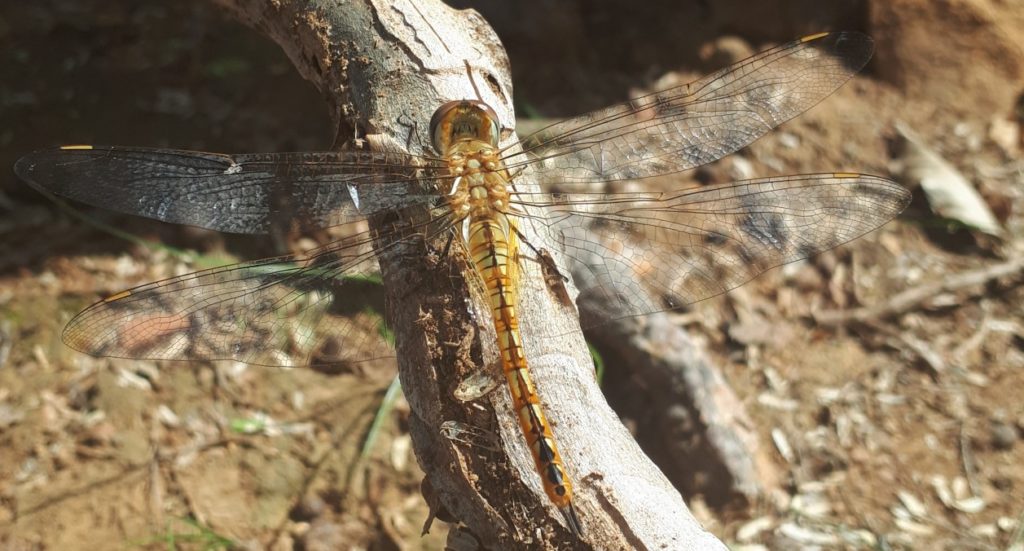
A female globe skimmer dragonfly pictured in Bonaire. Credit Johanna Hedlund
Migration flights by dragonflies and damselflies criss-cross much of our planet, new research reveals.
Scientists from the universities of Exeter and Lund reviewed global evidence and found 100 dragonfly and damselfly species that migrate, and a further 85 possible migratory species.
This means that only 1.5% of all dragonfly and damselfly species migrate (or 2.9% including possible migrants) – but the migrations can include millions of individuals, and some travel thousands of kilometres.
Most of these species are listed as “Least Concern” on the IUCN Red List of Threatened Species, suggesting migratory habits may make them resilient to rapid environmental changes caused by human activity.
“Dragonflies and damselflies are not usually thought of as migratory insects,” said Dr Johanna Hedlund, from Lund University and Exeter’s Centre for Ecology and Conservation.
“However, our review found evidence of migration in four dragonfly families and two damselfly families, and analysis suggests migration has evolved independently multiple times.
“Given the distances covered and the number of individuals involved, these migrations are likely to have considerable impacts on ecosystems, including moving biomass and nutrients, and controlling pests.”
Migratory dragonflies and damselflies typically live longer in their flying adult stage than non-migrants, some for several months, whereas species that do not fly long distances spend more of their lifetime as nymphs in freshwater.
Migration in dragonflies is likely driven by their habitats being unsuitable for breeding at certain times of year, often due to cold or extreme heat or drought.
Unlike birds and mammals, most insect migrants do not complete a round-trip journey within their lifetime. It is subsequent generations, the offspring of the parent dragonflies that once left, that return to the original breeding location.
However, the study found evidence of both this common type of multi-generational migration (descendants of earlier migrants return to the breeding habitat), but also of single-generational migration (an individual insect leaving a location then returning).
The only single-generation strategy found was “altitudinal migration” – moving to higher ground to avoid hot and/or dry conditions in the breeding location.
Japan’s red dragonfly (Sympetrum freqeunce), known as “Akatane”, is an example of an altitudinal migrant. After emerging as flying adults late spring, red dragonflies escape the hot valleys and retreat up the mountains where they then spend the summer. The same individuals then return to breed when the weather cools in autumn, and huge swarms of them can be seen on Japanese hillsides.
Other fascinating species include:
- The globe skimmer (Pantala flavescens), which carries out long-distance migrations such as flying more than 2,500km from north-east India to the Maldives. They fly on rain-bearing trade winds, allowing their nymphs (which develop rapidly in just 40 days) to grow in rain puddles that are free of predatory fish. Globe skimmers are found in many parts of Asia, Africa and North America, and genetic testing suggests populations worldwide are connected.
- The four-spotted chaser (Libellula quadrimaculata) is known to swarm in vast numbers in Europe, though recent decades have seen much less of this incredible phenomenon. Anecdotes from the mid-1800s describe enormous swarms through Belgium as consisting of “hundreds of millions of individuals”.
- The vagrant emperor (Anax ephippiger) is believed to fly from the Sahel in Africa to Europe in spring and autumn, sometimes reaching as far north as the UK and Scandinavia. This species used to be a rare visitor to the Mediterranean, but within the last 40 years it is now a common breeder there and there are annual reports of the species in the UK.
Dr Hedlund added: “Dragonflies provide important food for other migrating animals, as they form huge swarms that coincide with the migration of their predators.
“Many bats and birds – such as bee eaters, falcons and hawks – hunt them during their own journeys.”
Dr Hedlund highlighted the effects of climate change on insect migrations.
“Changes in wind patterns, rainfall and temperature alter when, where and how far insects can migrate,” she said.
“For example, migratory dragonflies from Africa, such as the vagrant emperor and the red-veined- darter, are becoming much more common visitors to Europe.”
The study was funded by FORMAS, the Swedish Research Council for Sustainable Development.
More information on Dr Hedlund’s work can be found at www.ecosystemsinthesky.com
The paper, published in the journal Biological Reviews, is entitled: “Flight of the dragons: a global review of migration in Odonata.”