
First papers published in major NHS cancer blood test trial
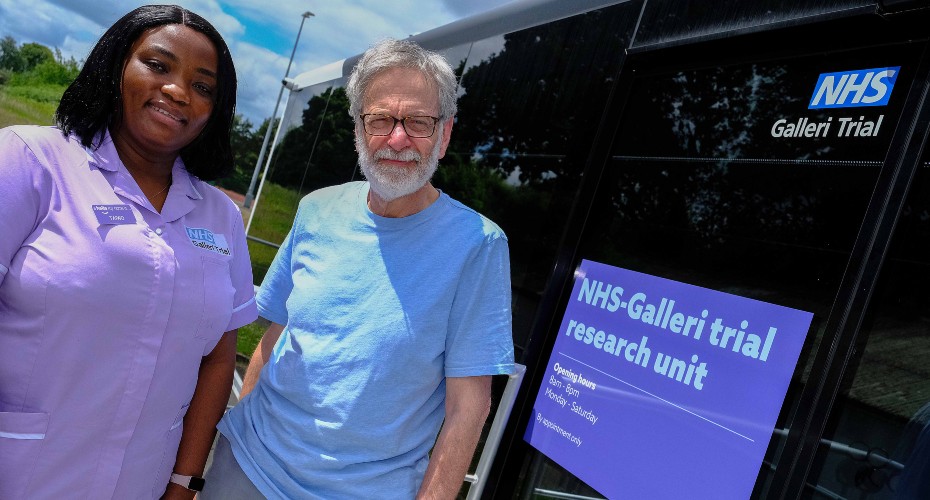
NHS Galleri study nurse with participant
A large-scale cancer trial investigating whether a blood test can help the NHS detect cancer early has published its first papers, both in leading international journals.
University of Exeter is part of the team assessing the NHS-Galleri trial, which involved 142,000 volunteers aged 50–77 from eight regions of England.
The trial is studying whether the Galleri® multi-cancer early detection test alongside existing cancer screening can help to find cancer early. The blood test can detect a ‘signal’ shared by many different types of cancer in a sample of a person’s blood.
Professor Richard Neal, at the University of Exeter Medical School, is trial co-lead, and author on the two papers to detail the first results from the trial, including whether using the Galleri® multi-cancer early detection (MCED) blood test changed the stage at which cancers were diagnosed and how the test performed.
The first paper, published in the New England Journal of Medicine, assessed whether the test helped to find cancer early and if it changed how people were diagnosed.
The paper also reports that fewer people were diagnosed with the most advanced cancers among those who had the test, when stage 4 cancers were looked at on their own. There were more early stage cancers (stage 1 and 2) in the test group. In people who had the test, more people were diagnosed with cancer after screening and fewer were diagnosed in an emergency situation.
However, the paper reports that there was no difference in the number of people diagnosed with late-stage cancer overall between people who had the blood test (test group) and people who did not have the test (control group), when stage 3 and stage 4 cancers were looked at together. This means that the trial did not meet its main goal.
The second paper, published in the journal Nature Medicine, provides data on how accurate the test is. It found that around a third of people who had cancer got a cancer signal detected (‘positive’) test result. Nearly everyone who did not have cancer got a no cancer signal detected (‘negative’) test result. This means that the test gave a false alarm less than 0.5% of the time. Around one in 100 people had a positive test result. Around half the people who had a positive result were diagnosed with cancer.
Professor Richard Neal, of the University of Exeter, is Co-Chief Investigator for the NHS-Galleri trial, said: “The publication of these two papers in two world-leading journals marks a major milestone for the NHS-Galleri trial and for the clinical evaluation of MCED tests. As the world’s first randomised controlled trial of an MCED test, NHS-Galleri provides the first evidence of its kind on whether using the test can change when and how cancer is diagnosed. These publications are a testament to the years of work by our research teams and the extraordinary commitment of the thousands of participants who returned year after year to contribute to the trial.”
The papers provide more detail for the results presented at a scientific conference in May.
More results will be available in the coming months and years, as researchers carry on collecting and analysing data from the trial. The NHS and other health organisations will review the results of the trial in detail to understand how this type of test could be used in the future.