
Organisations seeking to adopt and innovate with AI must ‘look beyond the technology’
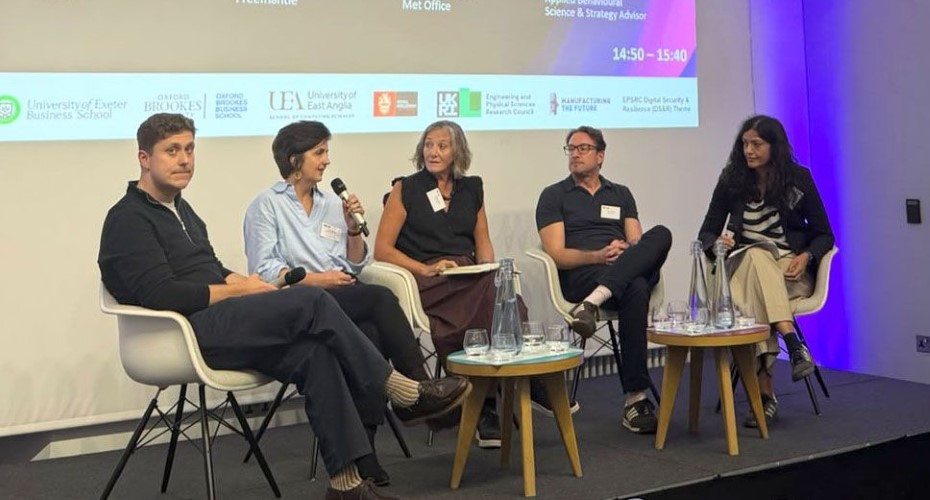
A panel at the DIGITlab innovation workshop
Organisations that aim to make emerging technologies such as AI essential to how they function must look ‘beyond the technology’ and focus as much on people, experts have said.
Speaking at the DIGITlab Innovation Workshop last month, Exeter’s Professor Saeema Ahmed-Kristensen presented five years of DIGITlab’s work on digital innovation, in which she stressed the importance of an approach to digital innovation in which technology is considered alongside people, organisations and the way work is actually done.
“We need to think beyond just the technology to consider human beings and the organisations around them. This includes looking at how business models need to transform to adopt AI and understanding how data moves through an organisation,” said Professor Ahmed-Kristensen, who is Director of DIGITlab, a digital economy research centre led by the University of Exeter Business School.
The event, held at the Royal Academy of Engineering in London, saw leaders from government, industry and academia gather to explore the opportunities and challenges shaping digital transformation across sectors.
It featured an engaging keynote address from Dr Dave Smith, National Technology Adviser at the Department for Business, Innovation, Science and Trade, who argued that new technology adoption is often misunderstood because organisations focus on acquiring the technology rather than changing the work around it.
He said the wrong way to introduce technology is to “throw a tool at busy people doing their jobs”, and that organisations should instead “analyse workflows, understand critical paths, find cost drivers, find out where the information sits, where decisions sit and get stuck, where people duplicate, and then apply technology to that system”.
The workshop saw representatives from organisations including BT, Mistral AI, the Met Office, Fremantle, Mishcon de Reya and Agri-TechE join academic experts from across DIGITLab for a day of discussion and knowledge exchange.
Panel discussions explored digital transformation in agri-food and agri-tech, future challenges for digital innovation and the adoption of AI technologies across organisations, with contributions from leading voices across industry, government and academia.
The workshop showcased DIGITlab’s research into human-AI collaboration – including how interactive chatbots describing patient experiences can support more inclusive design of services; how large language models can enhance working together to evaluate design ideas, and how chatbots can support SMEs to understand digital transformation – as well as research on digital transformation and organisational innovation, while strengthening connections between researchers, industry partners and policymakers to support the responsible adoption of emerging technologies across the UK economy.
DIGITlab was set up in 2021 as an EPSRC Next Stage Digital Economy Research Centre with five years of funding, which will end in January 2027.
But rather than reflecting on past successes, the Innovation Workshop was firmly focused on the future.
“We’ve published a whole host of articles and academic publications,” said Professor Ahmed-Kristensen, addressing an audience that included industry and policy leaders, “but above all we’re about impact. We would like to hear from all of you about the new challenges and opportunities to help shape the directions that we should be thinking about as we want to leave a legacy that goes beyond just research.”