
Habits help animals survive
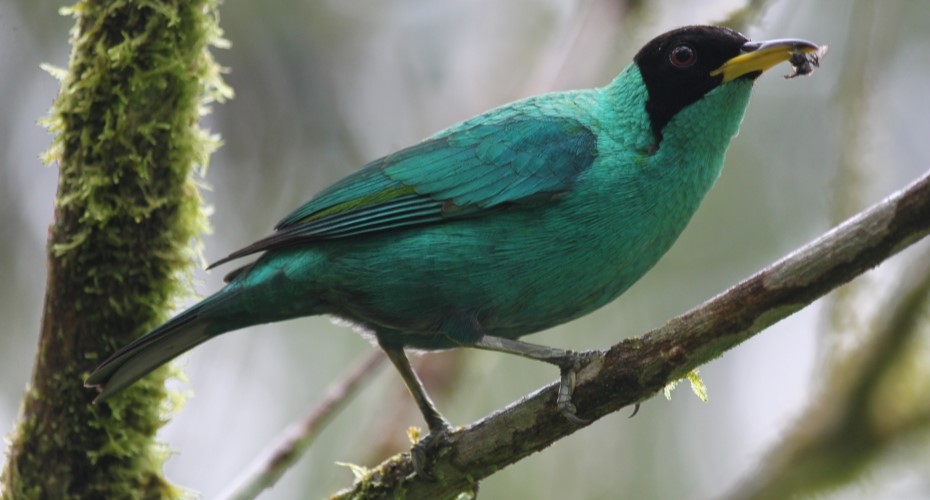
A green honeycreeper. Credit: Nico Thornton-Kent
The ability to form and break habits helps animals survive and find food efficiently – and may have benefitted our hunter-gatherer ancestors – according to new research.
Forming habits can make complex tasks “automatic”, reducing the mental effort required.
But breaking habits may also be essential if a habit is no longer beneficial.
The research team – from universities of Exeter, Bristol, Humboldt (Berlin) and Stockholm – created simulations to test the evolutionary pros and cons of forming and breaking habits.
They find that habits could help an animal forage for food while keeping attention free to look out for predators – suggesting evolutionary benefits for creatures of habit.
“Lots of psychological research has examined habits in humans – but we don’t often ask the same questions about animals,” said Professor Olof Leimar, from Stockholm University.
“Our aim is to change this, by investigating a possible evolutionary explanation for habits, namely that habits enhance an individual’s ability to multitask in a realistic ecological context for many animals.”
The team created simulations where virtual animals had various food choices, which they could learn about to exploit efficiently, and had to watch for predators.
Foraging habits could be formed, freeing up attention for evading predators, but sometimes the food environment changed – meaning new habits were required.
“We show that forming and breaking foraging habits can substantially reduce the chance of being killed by a predator, without drastically reducing foraging success,” said Dr Sasha Dall, from the Centre for Ecology and Conservation on Exeter’s Penryn Campus in Cornwall.
“This is effective as long as environmental conditions remain stable enough between changes.
“We argue that the ability to form and break habits is a type of behavioural flexibility that is likely to be favoured evolutionarily in a range of ecological conditions.”
Dr Dall added: “From morning coffee routines to familiar routes home, habits are often seen as mindless behaviours. But our study suggests habits may have evolved for a very good reason: they help animals stay alive.
“This type of learning is likely to have helped our ancestors – but things have changed very radically in our world, so the way that habits form and break may not be well-tuned to the current pace of life that humans experience.”
Dr Dall was supported by a Royal Society Leverhulme Trust Senior Fellowship for part of this work.
The paper, published in the journal Evolution Letters, is entitled: “Evolution of behavioral flexibility and the forming and breaking of habits.”