Acclaimed Ukrainian war poet to share frontline insights with British Commandos and general public
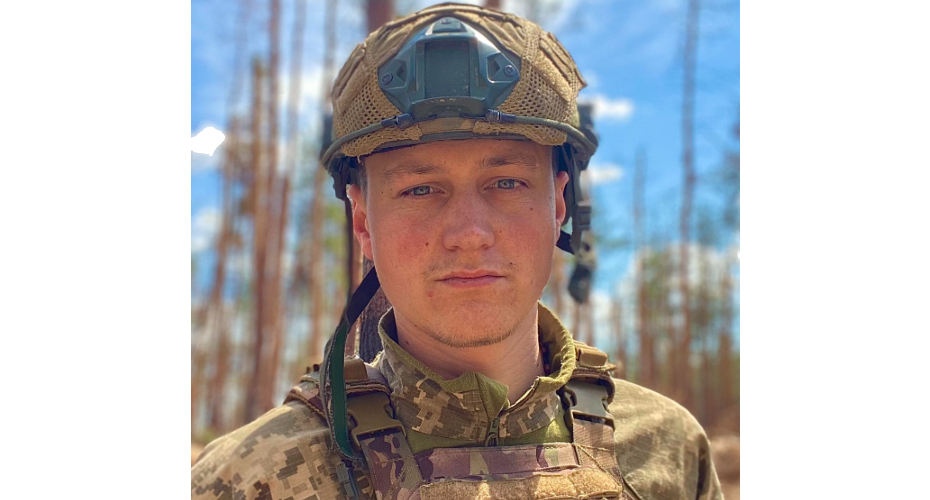
Artur Dron has had to endure multiple operations and a nerve transplant after being wounded by shrapnel
A former Ukrainian soldier whose wartime poetry has earned international acclaim is to visit British commandos to discuss the realities of frontline combat with Russian forces.
Artur Dron’, who joined the 125th Territorial Defence Brigade of Ukraine within days of Russia’s full-scale invasion until he was seriously wounded and demobilised, will speak to Royal Marines at the Commando Training Centre in Devon.
He will also deliver a session at 42 Commando in Plymouth and explain how his experiences of fighting Russia’s illegal invasion have fuelled his creative writing, as well as the process of physical and psychological rehabilitation he had to undergo.
The visit has been organised by Professor Hugh Roberts, a modern language expert at the University of Exeter, who has been coordinating projects to translate and showcase the new generation of Ukrainian wartime poets. It’s been supported by the Exeter Defence, Security and Resilience Network, with funding from a British Academy Talent Development Award.
Dron’ has been one of the most prominent voices of this new generation, and his work has reflected the cultural assault that Russia’s war has instigated. His 2023 collection, We Were Here, was largely composed while he fought for the 125th Separate Brigade in Donetsk, Kharkiv, and Zaporizhzhia. He was seriously injured the following year, and after a period of rehabilitation, was demobilised – all before he’d even reached the age of conscription.
“My experience of participating in combat on the front line of the Russian-Ukrainian war, being wounded and undergoing rehabilitation afterwards, and adapting to life after leaving military service are things that thousands of Ukrainian soldiers have gone through,” he said. “So, I am looking forward to sharing these experiences with the Royal Marines, and to thanking the British people more generally for their support.
“You are among our key, largest, and most important partners. I deeply appreciate this both as a veteran and as a citizen of my country.”
His collection of essays, Hemingway Knows Nothing (2025), a bestseller in Ukraine and a winner of the prestigious Yuri Shevelyov Prize, is forthcoming in ten languages this year, including an English translation edited in Exeter.
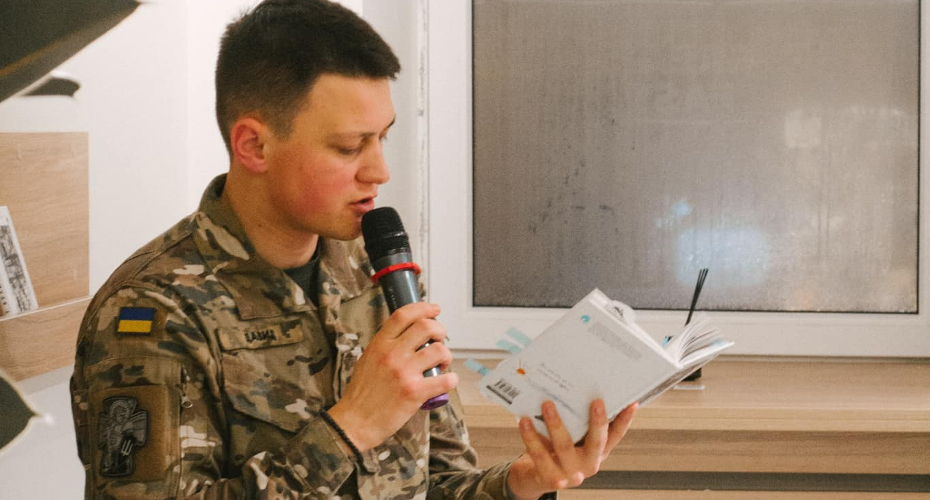
The themes of combat, rehabilitation and creativity will come together in the two events with the Royal Marines, scheduled for Wednesday 6 and Thursday 7 May.
The following night (8 May), Dron’ will speak in a public event at the French Institute in London, during which he will read some of his work and answer questions. The Ukrainian Institute is hosting the event, and it will feature insights into the process of translating Ukrainian poetry by Professor Roberts.
“Artur Dron’ is one of the leading figures of the renaissance of poetry and literature in Ukraine now,” says Professor Roberts, of the University’s Department of Languages, Cultures and Visual Studies. “I’ve had the privilege of being involved in bringing his writing to English-speaking readers since being introduced to it in summer 2023 by the poet Yuliya Musakovska, who identified him as a rising star and translated his celebrated poetry collection, We Were Here.
“Artur has a wonderful ability to convey a gamut of experiences and different Ukrainian voices in his poetry and prose, and to put it all in simple ways that speak directly to the heart. We’re very fortunate that he’s still with us, and personally, I’m glad that I honoured the deal I made when we met in person for the first time in Lviv – namely that the next time I saw him would be in the UK.”
Professor Roberts is currently leading projects funded by the Arts and Humanities Research Council, the British Academy, and the British Council to share Ukrainian writing. These projects also show how research in languages and cultures is needed now to foster understanding and bolster international resistance to tyranny.